Exclusive: World Confectionery Conference Brussels 2025: extended review

The Q&A on sustainability and the future for the confectionery sector, featuring Ferrero, Fairtrade, HRM Oba Dokun Thompson, ISM, and Rainforest Alliance, was among highlights of this year's WCC event in Brussels. Pic: Dafos/Bell
This year’s World Confectionery Conference made a memorable return to Brussels amid an industry facing core challenges, as editor Neill Barston reports from the Belgian capital
Major sustainability issues including prospects for EUDR environmental laws, as well as core industry innovation came sharply into focus for our latest World Confectionery Conference.
A highly engaged sector audience gathered once again in Brussels for our fourth live event, which provided plenty of memorable highlights amid its eclectic agenda. See our exclusive full video review below.
Attendees hailed from around the globe including across Europe, as well as representatives from the UK, Colombia and South Africa took part in our key annual event held at the Marriott Hotel, Grand Place, Brussels, which hosted our first event back in 2022.
From developments with new products and ingredients, through to equipment and systems for our wide-ranging sweets and snacks markets, its central goal of tackling the biggest subject matter of the moment, was delivered with an assured display from our keynote speakers.
The timing of our event in September came amid a period of immense change
for the sector, as it continued to grapple with the impact of US tariffs, and conflicts in Ukraine and Gaza (the latter nearing its end), as well as heightened costs of operating in crucial cocoa supply chains.
These hugely significant areas were under the microscope with our opening presentation from Aldo Cristiano, vice president of Caobisco European confectionery association, who also serves as head of sustainability for Ferrero in Germany.
While he noted many smaller and medium-sized enterprises lacked the resources to absorb the significant shocks affecting global markets, he felt there were reasons to be remain upbeat.
He asserted that Caobisco is working closely with its partners, including the European Cocoa Association to advance research into resilient cocoa systems for forging sustainable farming practices.

“Resilience is not built overnight, but it is through long-term investment, stronger partnerships with producing countries, and Fairtrade conditions, that will allow cocoa farmers to thrive.
“Beyond raw materials availability, we also face trade policy challenges, and transatlantic trade with the US remains critical. But in the context of ongoing trading tensions, the threat of retaliatory tariffs that took place before summer had posed great risk to our companies across Europe.
“An additional 10-20 per cent duty on US walnuts, pistachios and peanuts would have been an effective import ban for many operators.
“The results could have been job losses and plant closures and relocation of companies outside of the EU, so we urge policy makers to pursue negotiated solutions, and to protect sectors like ours, where access to raw materials is the foundation of competitiveness.”
As he noted, Caobisco had long advocated for major trade negotiations around the world, including the long awaited EU- Mercosur trade agreement with South America, which he said ministers had indicated would now being in placed by the end of 2025.
In his view, this could remove tariffs for more than 90 per cent of goods between the two major trading, reducing the cost of trading by up to €4.5 billion annually.
Moreover, he explained that the confectionery sector in particular stood to gain from the deal, allowing improved access to essential commodities including sugar, and improving market access.
On the hot topic of EUDR, he struck an optimistic tone over the policy, which holds companies to prove zero deforestation in their respective operations.
He noted: “This is another defining issue, and Caobisco fully supports the EUDR’s objectives. Our industry has long championed traceability and sustainability for chocolate and hazelnuts, and we remain committed to eradicating deforestation in our supply chains.
“But the reality is that compliance remains a formidable test, and SME’s
in particular face heavy administration burdens, and unresolved implementation issues are still generating confusion and hindering progress. So, together with our partners we are engaging with the European Commission to provide urgent clarifications and workable solutions to the critical issues identified, and we’re calling for consistent application across member states.”
In the wake of our conference, the EU Commission has in fact moved to propose an additional year’s delay on top of an already negotiated 12-month rolling back of the start date.

On protecting minors, he cited its decade- long partnership with the International Labour Organisation, which had prevented nearly 10,000 cases of child labour in hazelnut production, as a major case. He believed it served as a significant example of what could be attained by governments and civil society working jointly.
“We must go further on this, consumers demand it, and legislation expects it, and our planet requires it,” he concluded, noting that with support, the sector can adapt.
Major industry trends
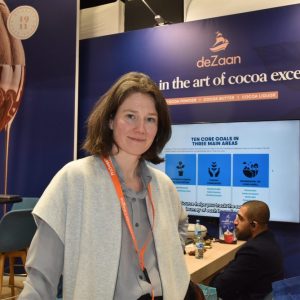
For our second speaker of the day, we heard from Honorata Jarocka (above), associate director at Mintel insights group, who offered an engaging assessment of the chocolate confectionery market.
As she noted, the segment’s future potentially lies in the elevation of indulgence, through delivering guilt-free options with less sugar, as well as embracing cocoa-free and longevity-themed innovation.
Furthermore, the analyst explored the notion of maximalism as a brand strategy, examining how manufacturers are going further than ever before in how they promote their products.
Moreover, it underlies a significant trend in brand strategy, presenting exciting opportunities through product marketing and advertising, which as Confectionery Production has reported, has now extended to collaborations with other brands, as well as with sporting and acting stars in a bid to drive product sales.
As Honorata asserted, the rise of bold branding is characterised by vibrant colours, layered textures and striking designs.
She said: “In chocolate confectionery, there is a growing opportunity to deliver multi-sensory experiences that engage the senses through flavour, texture and visual appeal, with taste remaining of crucial importance.
“In Germany, 47 per cent of chocolate consumers say unique flavours would prompt them to try a new product, while 24 per cent point to unique textures.
“In the US, 43 per cent of chocolate buyers focus on the fillings, while 26 per cent pay attention to the mix-ins when choosing chocolate products.”
Significantly, she highlighted the emergence of new trends, such as the development of “Angel Hair” pistachio cream and Turkish cotton candy fusion, which had been driven by social media – a factor that is proving an increasingly significant for product marketing.
In the analyst’s view, the new series could potentially rival Dubai Chocolate, yet the latter appears to be showing commendable retail staying power since its rapid ascent to prominence over the past 18 months on the international stage.
She highlighted several bold category releases, including Cadbury Dairy Milk introducing a limited edition “More” variety featuring a caramel layer, toffee filling and chopped hazelnuts. She also cited Ritter Sport delivering its Duo offering, combining caramel crush and big brownie offering.
Another factor Honorata noted was around category blurring, such as with co-branded and hybrid innovation, such
Seyma Ozonuk from Palsgaard discusses its AMP solutions for confectionery
as Gnaw’s mocha melts. These come in the form of chocolate cubes with a gooey centre that can transform coffee drinks with an indulgent added treat.
In addition, sugar reduction has persisted as a consideration, with maltitol, erythritol and stevia all presenting manufacturers with options on that front.
As the company’s research director noted, opportunities in this segment are most likely best explored in the dark chocolate category, which is naturally lower in sugar.

With an eye to future trends, she asserted that cocoa reducing cocoa content, as well as the continuing emergence of lab-grown cocoa free chocolate, will be among key pull factors for consumers.
Health and nutrition
Moving forward on a topic of product development, Sebastiano Collino, Ferrero’s global head of health and nutrition explained that its approach on finding the next generation of confectionery offering has evolved considerably.
He told the conference: “For our company, working on what products would appear on supermarket shelves, there was just one consumer, known as ‘Valeria,’ and many years ago in the 1960s and 1970s, that was a very easy exercise with just one person in mind.
“But with products that have been talked about such as Angel hair, and lab-grown cocoa, the needs of consumers are now much more diverse than 20 years ago, so that can offer a real challenge.”
As he added, business in the sector, including its own are spending a lot on consumer intelligence and research in a bid to keep ahead of an increasing array of competition.
He revealed that there have been considerable changes in the market that are shifting consumer behaviours. This has chiefly included demographic patterns that have resulted in ageing populations and reduction in household sizes. This that has impacted consumer spending power and buying habits.
“The new generation of consumers are delivering a big change, as we see how AI is linking people together with products – it’s the biggest change that is now happening. Artificial intelligence will change the way that we approach consumers.”
As he asserted, today’s shoppers are now demanding far more information than ever before on nutritional values of product ranges, which has prompted Ferrero, as much as any other leading companies to re-evaluate its offerings.
“We want to be healthy, but we want to continuing being able to treat ourselves, which creates a problem as that it is very hard to define what is healthy, with the market being very segmented,” speaking on consumers desires for both indulgent ranges and healthier options, including reduced portion sizes.
In response, Ferrero has invested in brands that augment its core staples such as Rocher, venturing into additional markets such as protein-enhanced options, as with its recently acquired Fulfil brand.

He concluded that “Ferrero has realised that nutrition is becoming an integral part of sustainability,” through providing a key role in supporting nutritional guidance for consumers.
Ingredients advances
For her part, Dr Isabelle Jaouen, research and development director for French-based Alland & Robert ingredients business, offered an engaging update on its latest product development activities, as well as explaining its distinctive processes.
As she stressed, the company has been built upon strong family foundations, now being in the fifth generation hands, with Charles Alland recently taking up the role as its latest CEO.
“We’re a world leader for the production of acacia gum, and we’re exporting around 95 per cent of our products,” noting that
its ranges have required careful sourcing from acacia trees from sub-Saharan Africa, between Eritrea to Senegal.
“We work with these countries with specific partners in order to gain the crude gum that is treated and purified in our plants. The world production might seem
Dr Isabelle Jaouen, of Alland & Robert, gave a key presentation on its acacia capabilities quite small compared to coffee or cocoa at 80,000 tonnes, but we represent around a third of the global production, and our products are sustainable, as acacia trees prevent desertification,” she says of its longstanding operations.
As she noted, acacia gum has wide ranging use, with its high soluble nature proving versatile, including for applications in confectionery. It is used as a texturing agent and for coating, as well as aiding the mouthfeel of product series.

Indeed, the company’s latest application, its Syndeo gelling system, has been based upon acacia gum as a replacement for gelatin or pectins, and successfully claimed our ingredients development of the year award at this year’s Brussels conference.
“Flavours, beverages and confectionery represent nearly 75 per cent of the applications, but we work every day in our R&D department in order to promote the use of this gum, or fibre, in everything from dietary compounds, dairy products, as well as within pharmaceutical ranges. It’s a fascinating product,” adding that some of its most significant uses for sweets had been seen within gummy ranges. She also noted that it has been used within chewy and hard-boiled candy series.
Significantly, she enthused that it is particularly useful in terms of assisting with improving the nutritional value of product ranges, as the gum’s core properties are said to compensate for the loss of volume in developing sugar-reduced confectionery.
Enlightening emulsifiers
Significantly, the event also saw a return for Seyma Ozonuk, application manager and team leader for confectionery and bakery and Palsgaard’s Turkish operations.
She discussed the virtues of one of its core AMP emulsifier systems which are designed as an alternative to applications such as lecithin use to improve overall chocolate quality.
As the specialist detailed, its long- standing solutions have been devised to help make a considerable difference to manufacturers’ operations in terms of potential efficiency savings compared against other methods within confectionery manufacturing.
During its well-established history, the business has gone on to devise applications across confectionery, bakery and snacks, as well as well as with ice cream markets.
Significantly, this includes recently expanded facilities in the Netherlands for its PGPR (polyglycerol polyricinoleate) co-emulsifier primarily used in chocolate production to control flow, reduce viscosity and optimise moulding and enrobing.
“We’re only allowed to use three types of emulsifiers in real chocolate because of regulations, which poses challenges,” she noted of its operation. Despite these tests, there remains a notable market for its range of applications.
Speaking on the ice cream market, she confirmed that manufacturers had found its AMP systems particularly useful in terms of reducing levels of fat within recipes.
As she noted that the technology behind its several PGPR systems business has evolved considerably over the past few years, which has enabled the company deliver on a wide range of projects. This has included assisting businesses in extending the shelf- life of their respective confectionery ranges. Furthermore, she noted another key factor in its production processes from its core site in Denmark and other sites, has been a dedication to sustainable manufacturing.
“One of the key things to consider is that our production is in carbon neutral factories, changing our sustainability practices in 2018, so we are now trying to collaborate with our chocolate producers to reduce their own carbon footprint by using our emulsifiers,” concluded Ozonuk.
From there, we heard from Thomas Steinbrecher, group leader of technical services at Eastman Chemical, who offered a key presentation alongside invited guest business, Hans Brunner.
The duo delivered a joint presentation under the banner of ‘driving performance, safety and sustainability in chocolate mould innovation,” in reference to a recent combined project.
As Steinbrecher described, the business was able leverage its expertise in sustainable plastics to present Hans Brunner with a viable alternative to its standard moulding lines.
This took the form of its Tritan Renew, made from a total of 25 per cent recycled content, with the product line said to help offset the use of fossil fuels, as well as help reduce greenhouse gas emissions during manufacturing.
The joint venture came at a point at which Hans Brunner itself had placed greater emphasis on sustainability, including devising a cooling process using natural water sources, plus engaging with solar energy, and a drive to recycle used moulds and additional materials.
“In the chocolate mould business, we have been given a transition period of three years to be rid of plastics that had previously been used for more than 50 years, and to find a BPA-free (Bisphenol A) alternative – it’s quite a complicated and involved a lot of testing. And with Eastman we found a partner that could provide those materials,” explained Markus Gebhart, general manager for Hans Brunner.
Palm oil progress
For our final session of the morning, Angeline Camus of the Roundtable on Sustainable Palm Oil, offered an insight into its work of driving forward standards of certification within the sector.
The organisation’s European government affairs manager examined sustainability beyond legal compliance. This included examining the basics of palm oil production processes, through to exploring what makes it so widely adopted across the industry.

As Angeline observed, last year, 165 million metric tonnes of palm oil were produced, which is anticipated to increase to 305 million by 2050, with confectionery and snacks enjoying a notable market share.
For its part, as she explained, the RSPO as a non-profit group has been driving standards in the sector for just over two decades. Its founding members including the WWF, Malaysian Palm Oil Association and Unilever, with its HQ in Kuala Lumpur.
To its credit, the organisation now has 6,000 member groups and nearly 7,000 certified supply chain facilities across 105 countries. Its core principles revolve around respecting communities and human rights, as well as promoting ethical, transparent supply chains.
“What makes Palm oil so popular in confectionery? It is a very productive
crop, and very versatile. It is used in many products, and makes up 8.6 per cent of land in this category and is used in 40 per cent of vegetable oil products in the world, but with that popularity comes challenges, which is why we were founded over two decades ago.”
It presently certifies around 20 per cent of global production volumes, and much of its work comes in trying to bridge that gap in reaching even further into wider industry production chains.
As regards its certification systems,she noted that its standards aligned with those of incoming legislation outlined with EUDR laws coming into force, and a critical element of its work is in promoting third- party certification of performance results to ensure transparency of operating.
Significantly, she added that there had been some frustration that sustainability has always been linked with product ranges being seen as more expensive.
However, she explained that consumer research indicated nearly 50 per cent of younger generations of shoppers regard environmental claims as being important as core purchasing factors.
Snacking sensations
Our opening afternoon session was ably kicked-off by Tristan Hover, senior analyst with Euromonitor International. He offered intriguing insights into several product categories including ice cream, protein bars, crisps and fruit bars.
As he enthused, one of the overarching themes has been in manufacturers seeking to devise more health-focused product ranges in response to sustained consumer demand.
Moreover, for the plant-based ice cream category, he cited Euromonitor research forecasting CAGR growth of five per cent over the next five years, with summers becoming warmer amid climate change among core factors for category increases.
“Health is a very connecting driver when it comes to our market projections
on plant-based and vegan items, and why people purpose products. It’s mostly around health-related claims. One example of this is a survey on reasons for purchasing plant-based dairy ranges – the top response was to ‘feel healthier,” noting that amid a challenging economic period for many markets, concerns on sustainability and environmental impact were in fact of less significance.
Moreover, regarding the protein bar market, the analyst believed sales results showed that the segment remained hot property.
“Protein has been a trending ingredient currently, and it is sports nutrition and bar categories that are doing well in terms of online sales, and it is younger generations that are responsible for this growth in Europe as well as the health trend, with brands enjoying success with introducing many new flavours, compared to some areas of snacking,” adding that in addition to health products, other areas of wellbeing such as CBD-based product ranges that are promoted as anti-stress, are also anticipated to see sustained interest.
South American sustainability
For her part, Julia Ocampo, Colombian- based sustainability specialist with Luker Chocolate, offered an inspiring keynote on the work of the business.
It has specialised in sustainable cocoa for more than a century, expanding its reach into the B2B chocolate global export supply sector during the past two decades.
Last year, the company claimed an accolade at our conference, recognised for its environmentally and socially-mindful practices of its international operations.
Describing its work, Julia said: “We collaborate with cocoa farmers every day, most of whom are smallholders of around three hectares, and are spread across Colombia.
“This means it can be more difficult to work together – maybe three hours away from each other, but we’re working with a total of 65,000 families, producing 70,000 tonnes of cocoa.
“While our farmers represent just 1.5 per cent of production for the country, what is really nice is that we have equality and sustainability. We believe that we can bring about change in the value chain through delivering on sustainability,” noting around half of its harvests are for domestic use, with a large local preference for drinking chocolate.
The remainder of its cocoa is used for international markets, and is used in a wide range of confectionery brands, including Hames Chocolates and Love Cocoa within the UK.
“I’ve loved working for this company as we have offered premium chocolate products that have prioritised the wellbeing of farmers and the environment and are a family-owned business, co-creating with communities.”

As she acknowledged, the business is motivated by awareness of key climate change challenges, which “represented the biggest risk in cocoa’ and has prompted it to focus on environmental restoration through encouraging biodiversity.
While she conceded that forest loss linked to cocoa did occur in Colombia,
the company has operated on a model of monitoring its local environment and fostering animal habitat protection. This has included monitoring of ‘dry forest’ areas by cocoa farmers, which has enhanced their own farming capabilities and skills.
Furthermore, as Julia noted, the company is strongly invested in delivering on social rights and opportunities, offering a strong focus on community education, as well as supporting young people in cocoa growing regions.
As she explained there had been a pattern of younger generations not wishing to work within cocoa, which the company has tried to address through offering positive support and opportunities. This led to the creation of its ‘chocolate dream’ programme, born of a belief that cocoa can change lives, based on a long-term commitment to created shared value at origin production level.
Crucially, the business has remained honed on helping forge economic resilience through offering farmers a living income, as well as encouraging them to explore income diversification opportunities.
Buffering systems
For her part, Willy Van Arkel-van Arendonk made a notable return to the conference representing Corbion, offering an inside track on its buffering ingredients systems for confectionery.
As the director of product development noted, consumers have increasingly demanded bolder flavours from their sweets, which has required an ever-faster cycle of innovation for manufacturers. This is against a backdrop of rising production
“At a technical level, buffers regulate pH, at a business level, they help streamline processes, reducing manual handling and production downtime.
“They Enable flexible recipes, letting you launch multiple SKUs faster, as well as ensuring consistency, protecting your brand
reputation across markets.”
As she stated, 80 per cent of Europeans define flavour as the most important factor for sour products, including gummies. Fruit flavours remain hugely popular, with six in ten launches last year featuring fruits as a key
“Think of buffers as an enabler — one small change that delivers big gains in operational performance and market.”
Crucially, through using Corbion’s buffering systems, its partners have achieved faster processing times. They have also reportedly benefitted from lower labour and handling costs, as well as delivering more predictable batches.
Discussing equipment, Tjalling van der zee, spoke as Netherlands and Western European manager for Cama Group.
He offered a breakdown of its core packaging equipment ranges that have been widely used across confectionery markets.
With its recently developed HQ in Molteno, Italy, the business has grown steadily over the past 40 years.
According to Tjalling, the business has continued to enjoy key success including within confectionery, bakery and biscuits, as well as moving into dairy and ice cream, as well as coffee markets. Its packaging lines have handled a broad array of options including pouches, doypacks, tablets as well as tablets and containers.
Moreover, the firm has continued to thrive in working with some of the sector’s with leading brands such as Nestlé, Mondelez and Mars, through to Netherlands-based Tony’s Chocolonely. “We’re deeply committed to
sustainability and invest heavily in R&D to stay ahead of market demands and regulatory shifts, with the global challenges of recent years — whether economic, environmental, Political or regulations are reshaping the packaging industry,” noted Tjalling of present market conditions.
He continued: “One of the most significant developments is the introduction of the Packaging and Packaging Waste Regulation, or PPWR. This is a major legislative shift introduced by the EU to tackle packaging waste and promote
a circular economy.
What’s important to understand is that this regulation is mandatory for all EU member states, meaning it will have a widespread impact across a wide spread of related industries. “For packaging producers and machinery suppliers alike, this means adapting quickly to new standards—especially around recyclability, material use, and waste reduction,” adding that this had led it to develop innovative solutions including its Gorwrap mono-material labelling system, delivered through working closely with its customers.
Our final presentation came remotely, from Canada’s Bartek Ingredients, extolling the virtues of “Mallic Mania,” as its vice president of innovation,
Milad Moshfeghian, explaining just how these ‘hidden workhorses’ of the confectionery sector can make a difference to manufacturers.
As he noted, one of its greatest properties is in assisting with lingering of tastes – particularly with sour flavours, making it exceptionally on trend with the confectionery market.
In addition to assisting in flavour development, these acids have also great function use in helping regulates overall acids in production, ensuring enhanced recipe consistency.
Sustainability in the spotlight
For our centrepiece event, our conference turned to the Q&A on sustainability and the future of the confectionery sector.
From cocoa supply chain challenges, through to how technology including AI systems are expected to influence our markets ensured a lively range of debate among our expert panel.“

This included Francesco Tramontin, vice president, EU institutional relations and group public policy for Ferrero, who turned his attention to the landmark EUDR policies.
“With EUDR, we have very much embraced the concept of it, and we believe policies such as this will be good. The reason for doing this is not because it was easy for us or anyone else, but that it creates a common framework for doing more.
“There is some pushback on these policies, but the work still needs to be done, so I think you can make a difference with it through traceability, and this also includes a certain degree of investment in inclusive systems, which is something that needs to be done at scale.”
In his view, such systems could help drive overall standards, as well as providing consumers with guarantees of companies’ performance linked to legally- binding targets.
What’s more, from an NGO perspective, engaging directly with farming communities is at the heart of many of their activities. For our sustainability panel, Francesco was joined by Jason Archie-Acheampong, sustainable cocoa sourcing lead for Fairtrade Foundation, alongside HRM Oba Dokun Thompson, traditional Nigerian ruler and founder of International Cocoa Diplomacy. They were alongside Sabine Schommer, director of ISM Cologne, and Thierry Touchais, Southern Europe representative for Rainforest Alliance.
Together, they expressed how the industry was moving forward with greater urgency with regards to shared challenges of climate change, major legislation tests including new corporate due diligence laws also going through the European Parliament, and how technological breakthroughs can help shape the sector.
Speaking on its efforts to engage with supporting farmers, Jason Archie- Acheampong commented: “Our focus is through three main ways – our standards, our pricing mechanism including the premiums we pay, as well as our programmes on ground. These are helping drive impact in addressing some of the risks that farmers face. This includes working with other organisations to
help drive a living income,” he remarked of its ongoing mission to support key agricultural communities.
For his part, HRM Oba Dokun Thompson explained how he has taken
on the role of regional traditional ruler in Eti-Oni, Nigeria, explaining that his family had managed the oldest plantations in the country that were founded in 1896.
“When I took on my role as a custodian in 2008, the most important thing was to see how to revive the community. It had been in a state of neglect for about 40 years because of the extractive nature of cocoa, and we had to turn their fortunes around.
“We had to look at how to return dignity and self-worth to the farmers, and bring attention to the community, and see how we could refine the area’s resources for creating value and a cultural renaissance,” he enthused of collaborative efforts to support its cocoa growing. This extended to creating a specific festival celebrating its harvests that sparked a renewed vigour in the local industry.
From there, he established the International Cocoa Diplomacy Organisation, aiming to ‘bridge the gap between producing and consuming nations,’ with further initiatives including creating a new Nigerian chocolate, Gureje IV, through creating a partnership with UK manufacturer, Beeches Chocolates in Preston, Lancashire.
He stated that what is being done in Nigeria in the sector was ‘quite different from Fairtrade.”
In his view, the highly government- regulated cocoa markets of Ghana and Ivory Coast had not benefitted as much as could have been the case with nations such as his own, asserting that a less regulated, yet holistic approach to supporting farmers that was not centred entirely on certification, had yielded positive results.
Furthermore, the panel heard from Sabine Schommer, ISM director, who explained that from a broader industry perspective, companies were increasingly dedicated to delivering on their sustainability goals, which was becoming integrated into their operations.
In addition, she also referenced the fact that its own business model as Koelnmesse has sought to enhance its own environmental sustainability, with the design and operation of its extensive buildings tightly focused upon being as energy-efficient as possible.
“I think what we have seen here today
at conference, is at ISM in a larger scope, we have heard many great speeches and interesting examples, about how everyone right now seems to be struggling towards achieving a greater degree of sustainability. Whether that is in ingredients, packaging or in finished products, this is the most important topic right now driving the entire sweets and snacks community.”
For his part, Rainforest Alliance’s Thierry Touchais said that despite the organisation’s ambitious original vision more than 35 years ago, it ‘still had a mission to help farmers and to work through the whole supply chain which has a shared responsibility,” in helping those agricultural communities to thrive.
Beyond its certification standards, he explained one of its most vital areas of engagement came in the management of landscapes around the globe to ensure environmental protection.
As he added, the NGO has placed great emphasis on helping delivering best agricultural practices to improve operating standards within the sector to ensure that they are compliant with regulations that are coming through including the EUDR.
On the role of technology, he cited the key potential of AI in assisting with developing monitoring systems that are underpinning forest monitoring linked to the major ecological legislation that aims to create a level playing field.
As the panel drew to a conclusion, final questions were put to them, including one from Adrian Ling. The managing director of Plamil Foods, questioned just how equal Fairtrade actually was, given that in his assertion, a strong proportion of funding went on paying its own costs and senior management.
In response, Jason Archie-Archeampong stated its cocoa premium payments remained a strong marker of its mission and intent to pay communities more.
He believed the organisation’s overall community engagement measures were having a fundamentally positive influence in West Africa and around the
Industry’s time to shine.
Significantly, the event saw the presentation of six World Confectionery Awards that included a win in our finished product segment for the UK’s Prestat Chocolates with its take on Dubai Chocolate.
Meanwhile, the Equipment innovation of the year went to Schubert packaging
machinery, for its advanced cobot systems, which have been making key inroads within our industries.
For its part, France’s Alland & Robert claimed the ingredients honours of the year award for its advanced gelling solution for the fast-rising vegan gummy market.
Then, the emerging enterprise of the year accolade was claimed by UK-based Wild Thingz, founded by Fliss Newland. She has made a notable impact with her line of reduced sugar gummies that have enjoyed gains this year in securing key store listings. There were also honours for Kent-based Fudge Kitchen, which attained the Team of the Year award, with judges praising its collaborative, and close-knit spirit across the business.
For our closing key sustainability category, Natalie Quintero Zuluaga, director of global marketing for Colombia’s Cordillera Chocolate, collected the company’s award, with the business being recognised for its progressive programme successfully targeting support for women cocoa farmers (see our separate feature).
The awards sessions drew to a close on highly thought-provoking and entertaining note, as the combined series of presentations highlighting the collective need to continue positive actions to achieve global sustainability and innovation goals.
- The World Confectionery Conference moves to London next September (10th). For advertising and sponsorship opportunities, contact Dave Johnson at [email protected] and for our editorial programme, editor Neill Barston at [email protected]