

Exclusive: Chocoa 2026 places major cocoa topics under the spotlight

Chocoa's exhibition hall offered a key range of offerings from across the sector. Pics: Neill Barston
A determination to address major issues within the cocoa sector, including farmer pay, support and engagement with communities, and tackling climate-related issues were core to this year’s Chocoa event, reports Neill Barston.
Spread across five days as part of Amsterdam Cocoa Week, the annual industry showcase provided a broad range of interaction for the broader industry, including an opening day devoted to farmers around the world.
Among other key highlights of the event between 16-22 February was an evening dedicated to the Women In Cocoa and Chocolate network (WINCC), which launched its new mentoring programme at the event on its second day, with its third day given over to a trade fair, chocolate makers’ forum and its traditional Grand Dinner du Chocolat, as well as weekend public two-day chocolate festival to conclude its activities.

Confectionery Production played its part in reporting on Chocoa’s conference, which shone a spotlight on the true extent of crisis conditions facing the industry, which has seen marked crop price volatility alongside ongoing environmental and social issues that have negatively impacted on farming communities that have threatened its future viability.
Indeed, as Judith Sargentini, chair of the Dutch Initiative on Sustainable Cocoa (DISCO), and former MEP explained in her opening address, there was no hiding from the scale of the challenges facing the industry.

She noted that the pricing crisis had seen cocoa go from being traded at more than £12,000 a tonne at the start of last year, and slumping more than 60% below that level in the past two months, asserting that this level of volatility ‘was not normal’ for the sector, and underlined the severity of the core issues at hand.
In addition, she noted that revisions to major EUDR regulations on deforestation heralding major change for the cocoa sector were set to be further revised this April, placing further strain on the industry, which has seen the landmark laws already twice delayed.
Sargentini said: “With the next world cocoa farm gate prices due to be announced in April, Farm gate prices are expected to fall still further, and if they do, it will have an immediate impact on farmers, which is a systemic threat.
“And if you ask me, this threat must be central to our sustainable sustainability discussions this year. If the last three years have taught us one thing, it is that higher prices alone are not enough.
“Farmers need stability. Procurement policy, both cultural and public, plays a critical role. Our membership last year agreed a position on aligning purchasing practices, living income conditions and our wider goals,” conceding that while progress was being made, ‘we are not there yet,” against its targets.
Regulatory changes
Chief among these was further driving down deforestation-linked cocoa supplies, with the senior DISCO member stating that its members were around half way towards core sustainability targets.

She conceded there had been ‘much frustration’ among its members at the recently confirmed additional delay in Brussels over EUDR, which is now anticipated to come into being at the end of this year.
“In the meantime, our goal is to obtain higher than regulatory compliance. We continue to focus on reducing production and supply risks for smallholder farmers by ensuring that they get the support they need. Then there is also our our commitment on tackling child labour, which will recognise the child labour monitoring and remediation system, (clmrs), as the key tool for preventing and addressing child labour in cocoa producing areas.
“The progress on clmrs, deployed by our members, has been much slower than we would like it to be. A small group of front runners are implementing the system covering a significant share of their direct supply chain, but as a whole, this fund membership has only reached half of its impact,” which she added required an acceleration of effort from the industry, through developing robust, quality systems in line with emerging regulations. She noted that of the group of businesses operating in West Africa, the living income gap was known for around 40% of farmers that had been covered by industry engagement, with around a third of them covered by living income spending, which needed to be scaled-up significantly.

The opening session also featured a contribution from Stefano Gatti, of the Italian Ministry of Foreign Affairs and International Cooperation (MAECI). He explained that his home nation remained a key importer of cocoa, and as such recognised its importance within agricultural supply chains.
He cited the fact that Italy had devised its “Material for Africa” strategy, providing financial and practical support to the continent, with its resources remaining in place over the past two years despite pressing economic challenges elsewhere.
Plenary session
For its first major panel, the event examined key structural challenges that are a barrier to much-needed transition, such as land tenure and documentation restrictions on planting material, and access to services and finance. It set out to challenge whether there was the will of governments, industry and civil society, along with farmer representation, in order to bring about the kinds of system changes that agricultural unions in West Africa, as well as many market observers have long been calling for.
For his part, Michel Arrion (pictured below), executive director of the global ICCO cocoa organisation based in Ivory Coast, offered an overview of how the present crisis in cocoa had unfolded.

He explained: “When the prices went up in 2024/25, the stocks to (cocoa) grindings were on their lowest point. Today, we do not have large stocks. We make an annual assessment of their levels and they are at 1.3 million tonnes of beans in stock today in the world, which is around three months of production for the industry. It’s very tight.
“At the lowest point of the of the prices in 1991/92 we had 70% of stocks, and we have seen a surge in prices in the past two years basically because Ivory Coast and Ghana were producing less cocoa beans. We see in Nigeria, it has been stable around 300,000 tonnes, whereas in Ghana, it has gone down dramatically from 1 million tonnes in 2021, to just over 500,000.
“The only good story about production, certainly in terms of volumes, is Ecuador, where we see a constant increase of production in Ecuador. And it’s not the end of the story of Ecuador. I believe they are producing more and more. They reach about 550,000 they should be reaching 600,000 tonnes. And there are some predictions of the production will be producing more and more.”
Significantly, he observed a major trend of consumers around the world actually eating less chocolate within the past few years – which is not necessarily a conscious decision, despite a growing trend for healthier options being placed on international markets.
“It’s not that people are eating less chocolate. They think they eat the same quantity of chocolate, but the content of cacao with their chocolate is now lower, with cacao being replaced with substitutes, as well as the size of their tablets shrinking.”
In terms of solutions, he added that it was a question of trying to balance supply and demand, which would be achieved through keeping farmers at the centre of the debate and discussion. Significantly, he added that a major barrier to progressing agricultural improvements was the fact the majority of the cocoa sector still revolved around smallholder farming – with many agricultural workers having little or no access to finance in order to deliver any hoped-for improvements.
He noted that greater productivity levels (averaging only 400 kilos per hectare a year) were critical to making long-term improvements to the sector, which could be achieved through rejuvenating cocoa stocks, exploring appropriate farming diversification, improving agricultural practices and farming materials to protect against disease – which has remained a major persistent problem for many cocoa growing areas around the world, including West Africa.
As sessions during the week noted, around 40% of crops could presently be impacted by swollen shoot virus alone in Ivory Coast – which could result in farms being out of operation for around five years, such is he impact of the disease.
Carla Martin, of Harvard University, and The Institute for Cacao and Chocolate Research, spoke on the topic of how the sector is evolving to drive potential for retaining greater market values for origin communities.
She said: “When it comes to the local production of chocolate and its companion products, things like cocoa butter, cocoa powder, the distance between farm and factory has often been seen as a critical factor in profitability.
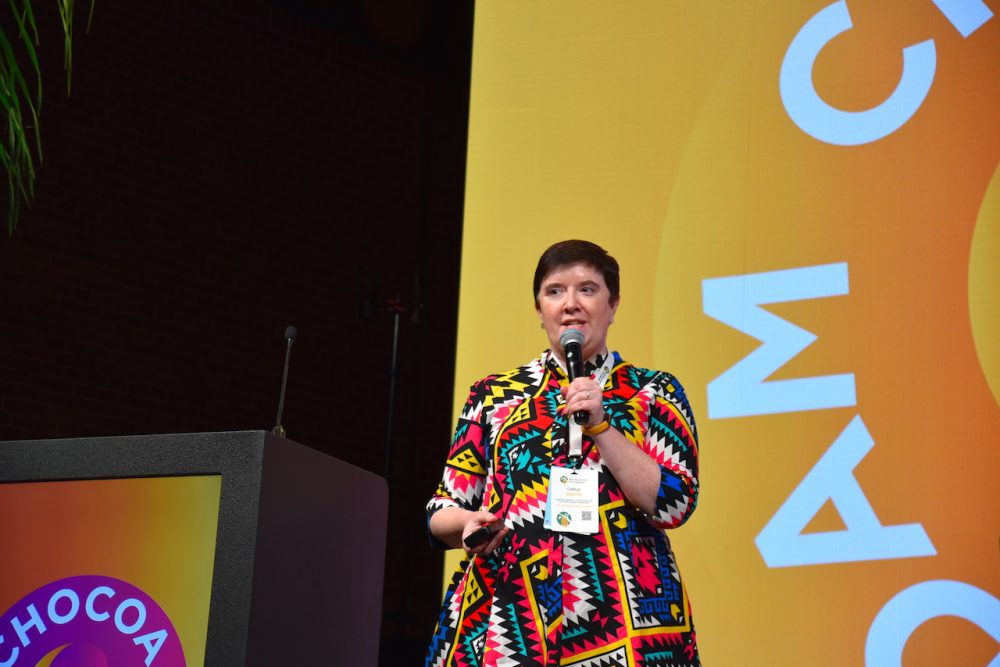
“You’ve also probably heard things like producing chocolate in the Tropics is difficult. There’s heat, challenges, humidity, electricity, transportation, but we’ve seen that these things can be superseded with careful planning. There are also advances in storage and retail that make this more feasible as time goes on. At the same time, increasing local consumption remains an area of exciting potential, noting that some progress was being made by companies that were starting to encourage young children to take an interest in food supply chains and school nutrition programmes from a young age.
She added: “But the goal to capture profit share locally remains elusive, and this is a real challenge of this idea of if we simply produce at origin, we might solve problems, and that is because there are tax havens that international businesses benefit from, that do not drive profit and share locally. There are also factories that do not provide large numbers of local employment. That said, we still remain optimistic about chocolate production in Africa for a number of reasons,” citing the fact that it can be a source of generating local pride in produce, as well as addressing the importance of best serving regional tastes in confectionery or other food ranges.
In addition, she also noted that there is potential for greater pan-African collaboration within the cocoa sector, with crops now being grown in a number of nations, which might open potential doorways for sharing best practice and improving productivity levels.

South American progress
Finally in the session, the audience heard from Colombian-based sector specialist Francisco Gómez, Luker Agrícola (behind Luker Chocolate), picture below who has gained considerable experience within the industry.
As he explained, within cocoa production there remains a close connection between sustainability and productivity, with farming requiring a close assessment of a number of key factors for success.
“There’s growth in our region, including with Peru, which is not yet as big as Ecuador, which has passed 200,000 tonnes of cocoa. Within a couple of years, 25% of the of top cocoa will be coming from South America,” noting that there were also moves in Brazil to raise its production, as well as in his native Colombia, which has come to value the cocoa market considerably.

He conceded that his home nation may have once favoured other crops including coffee and bananas, but there is a concerted effort to raise quality and quantity within the country, though this has required considerable effort in terms of propagating appropriate crop strains, as well as finely balancing the overall management of farming operations.
Women in Cocoa and Chocolate
The second evening of Chocoa featured a special event for the Women in Cocoa and Chocolate organisation, which launched its mentoring programme for aspiring female leaders within the industry.
Its chair and founder, Beatrice Moulianitaki, (pictured below) offered a notable opening address to the meeting, encouraging women to fulfil their potential within the sector, and strive to address the gap that still exists in female representation at senior level within many companies and organisations.
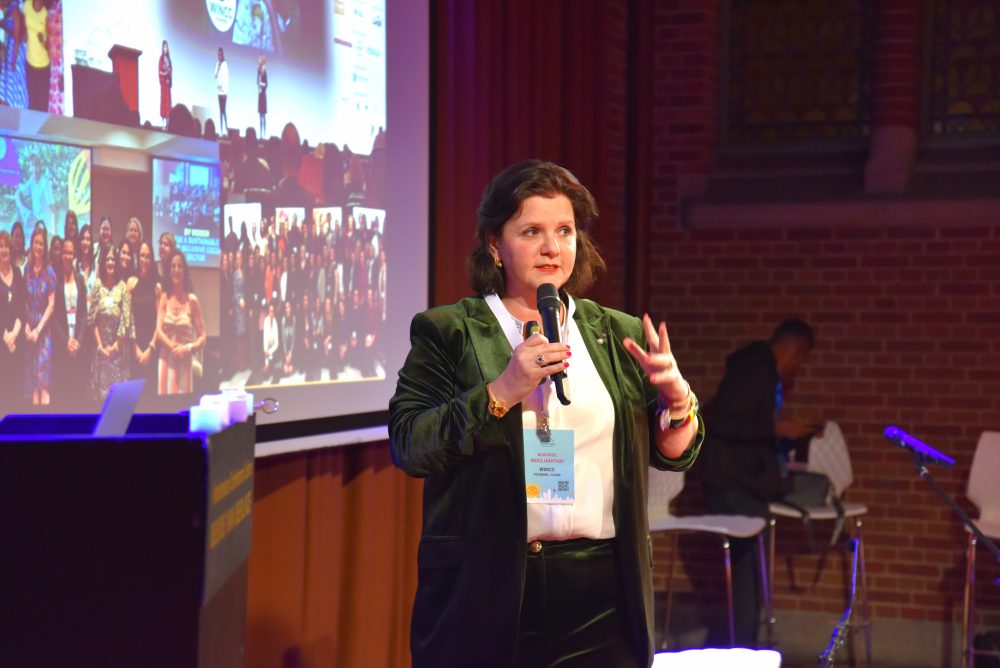
Beatrice Moulianitaki, founder of the Women in Cocoa and Chocolate organisation, launched a key mentoring scheme at Chocoa. Pic: Neill Barston
Notably, she highlighted the fact that of all roles in the industry, women only account for 25% of higher level of management within many companies, with little data being collected on this within the cocoa industry, though she expressed hope that this was now changing.
As she reflected, it had felt like something of ‘a crazy idea’ to start network off 10 years ago at the World Cocoa Conference in 2016, held in the Dominican Republic, and noted it has grown considerably, holding more than 20 events since its inception.
Beatrice noted: “We are an informal network. We are valued, and it seems that women have actually found what they were looking for at different levels in their in their lives. Some found network. Some found more confidence, some found friendships. Some even found new jobs through WINCC,” noting that there remained hurdles ahead in tackling gender pay gaps, and furthering the careers and community opportunities for women in the industry.
The panel discussion featured Jenny Davis-Peccoud, a sustainability specialist of management consultancy firm Bain & Company, who asserted that while there was ‘still growth in chocolate and cocoa’ there remained considerable challenges with pricing, and affordability that had impacted brands around the world.
She observed there had been a shift in messaging to the sector focusing on resilience – which translated in real terms for farmers as to whether they could withstand climate shocks and market volatility. For major corporations operating within the sector, she noted resilience represented a notion of having to diversifying supply chains.
In addition, Christine McGrath (far right of pic below), senior vice president for sustainability at Mondelez International, recognise the sector continued to face core tests, with the ‘world having changed so much’ since the business began its key environmental and social programmes more than 15 years ago, with there being no regulations governing the sector then.
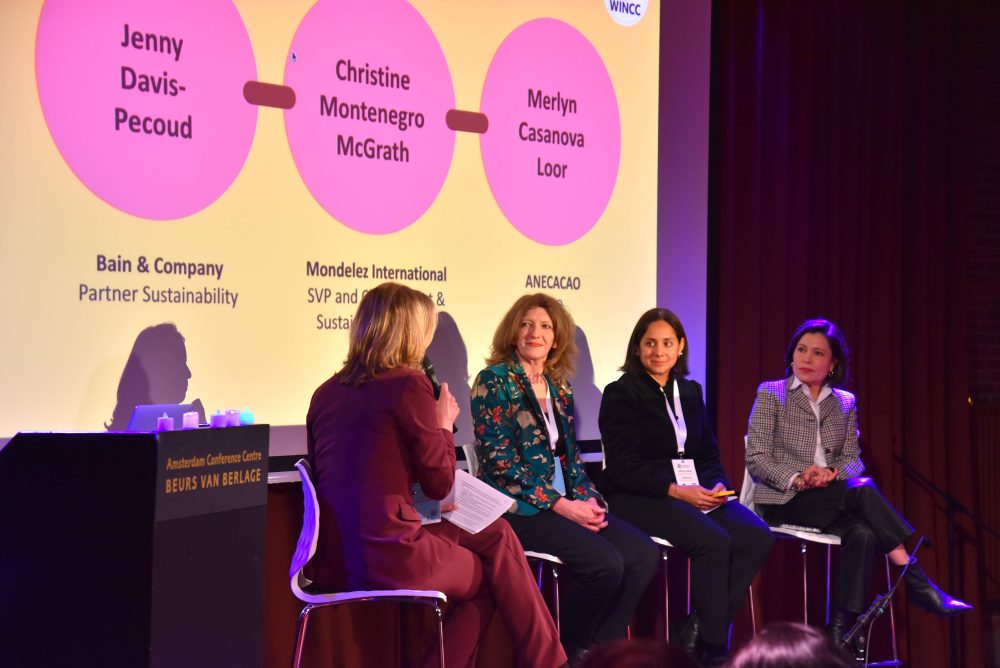
She said: “I have been leading our sustainability agenda since our company launched our programme programme in 2012, working with lots of partners and our wonderful team at Coca Life to create this work at scale.
“I think we are very bullish on snacks and chocolate in particular, and see lots of future growth potential for the business, and for our partners, farmers and communities.
“We work in a number of different origins around the world. We have a we work in West Africa. We work in Asia, we work in Latin America. I think when I what the question is, what do we need for the future to see the future of cocoa? We heard a lot today about the need to collaborate. I personally think these partnerships are about really listening, listening to the other side, and maybe trying to anticipate or be understand what it’s like to walk in their shoes.”
Event exhibition
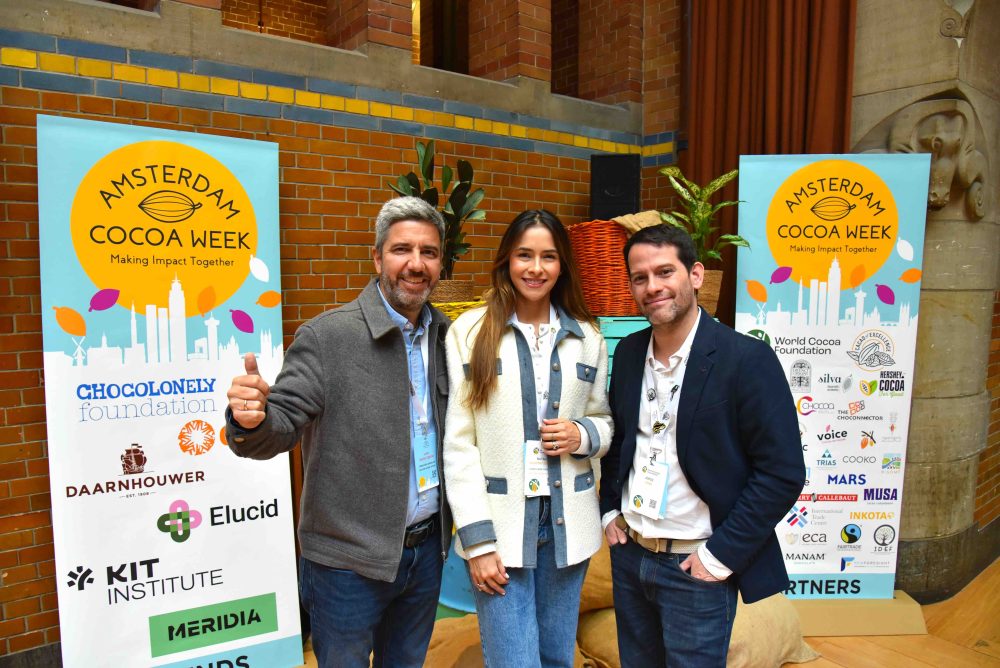
As in previous years, Chocoa has been supplemented with an additional exhibition hall, which has showcased key areas of the industry.
This took the form of everything from fine flavour chocolate brands, through to ingredients and equipment manufacturers serving the cocoa and chocolate sector, who offered an added dimension to the event.
One such business, Netherlands-based Caotech, stated there had been a strong response to its engagement for the 2026 edition.
Olaf Schepel, sales director for the company, commented: ‘ In the past, Chocoa was just a conference, and then they started with tabletops when it was held at the Buers Van Berlage for an extended exhibition.

“So we have been here from the beginning, and we attend because we want to support, cocoa in the Netherlands, and of course, with the venue only an hour drive from us. We find it very interesting to see industry developments, especially in the origin and organic chocolate.
“It’s good to be here to present that Caotech is very much interested to work with potential customers. And actually we have been very successful here with some machine selling in the past years,” adding that major companies such as Hershey had increasingly sent delegations to visit the event, which further enhanced its reputation.
While the senior sales director noted that cocoa prices had caused notable concern across the industry, this had not in fact dented sales of equipment from its own perspective.
For its part, Netherlands-based business Lareka, which specialises in packaging systems for the confectionery sector, was also among returning businesses at the show.
Pep Smulders, marketing specialist for the company, noted that there had been a good response to the company’s presence in Amsterdam, with the firm placing its BTB25 packaging line in the spotlight once more, targeting bean-to-bar producers.

In terms of producers, there was a broad spread of business representing cocoa and chocolate production from around the world. Among them, Spanish-based Tiger and Bean, specialising in the delivery of chocolate crumb, as the core ingredient for development of milk chocolate ranges.
Enthusing on the event, Robert Brunt, founder of the company, noted that there appeared to be an encouraging level of engagement at the event, which came in the wake of an especially eventful period for the business.
Evolving over the past decade, the company has gone on to claim a number of sector accolades, serving small and larger enterprises alike, as well as developing its own chocolate as well. But its production could easily have been halted due to unforeseen events.

“Last year, we had been flooded pretty badly in Valencia and our factory was hit quite hard, and it took us a while to rebuild it, but we are back on our feet now, but that was challenging along with the prices we have seen, explained Robert of its rollercoaster experiences of the past year.
“One of the things that we’re doing is, when we’re selling the powders to bean-to-bar makers, most of the beans of our makers, that they offer their clients is high cocoa content products, dark chocolate, sort of, you know, 70 80% cocoa. Most of them don’t have a plant based milk chocolate, and by having a plant based milk chocolate offering, it means they can reduce cocoa content to 40%. So essentially, it’s also a cost saving, as well as being a great tasting alternative to milk chocolate.

“There’s a nice mix of people here at Chocoa. That’s what we were really hoping for, actually, because we’re quite interested in meeting small scale beans bar makers. But we’re also, you know, open to speaking to larger industrial manufacturers as well. So it’s been a nice meeting,” added the sector entrepreneur on what proved an exceptionally eclectic event across its week-long array of activities in the Dutch capital that underlined the power of possibility within the industry, if collaborative initiatives continue to be translated urgently into action on the ground around the world.


