Exclusive: World Cocoa Foundation Partnership 2026 meeting concludes with call for decisive action

The World Cocoa Foundation Partnership meeting's second day included a panel on the navigating key shocks. featuring l-r Julia Buech, of Rabobank, Francesco Tramontin of Ferrero, and Gary Guittard, CEO of Guittard Chocolate Company. PIctures: Neill Barston
A firm commitment to delivering collective action supporting cocoa supply chains and building greater resilience within the sector emerged as a defining theme for the concluding day of the WCF’s partnership meeting, reports Neill Barston.
More than 500 senior delegates from around the world attended the Netherlands event in Amsterdam this week, amid significant challenges for the industry, as prices slumped to below $4000 a tonne, prompting authorities to cut farm gate pay by nearly 30 per cent in Ghana – and in quick succession within neighbouring Ivory Coast.
The topic of market volatility was squarely tackled in Mark Taylor (below), Hershey Trading’s strategic sourcing director of commodities, opening remarks, who asserted that supporting farmers was of critical importance.
As he noted, there were ‘no silver bullets’ to the many tests facing the industry, but he asserted that “its focus is on farmers’ first, and bringing risk and long-term thinking into the frame as part of our day-to-day realities,” in its sourcing strategies.

This has included a major $500 million Cocoa for Good programme, which has involved working with key regional organisations such as CARE, the International Cocoa Initiative, and Conseil du Cafe-Cacao, devising initiatives such a financial training for farming communities that it is intending to scale up to 40,000 households, as well as investing in education programmes within the region.
Taylor noted: “We’ve also seen the importance of hands on practical support, farm level, through training farm coaches, we work directly with farmers to co develop plans to improve, use and strengthen day to day decision making and of course, resiliency depends on the health of the world itself.

“So we’re advancing regenerative cocoa practices that support forest protection through the cocoa forest initiatives as well as other forest protection programs. We’re also working with partners to improve traceability and prevent deforestation. These efforts are about strengthening the social, environmental foundations that farming families rely on so they’re better positioned to withstand volatility,”
Plenary session
As the World Cocoa Foundation noted, operating in an era defined by shifting consumer preferences, climate change, sustainability regulations, and evolving trade dynamics, Ivory Coast and Ghana are facing major tests meaning that cocoa stands a crossroads in its future development.
A key panel session explored some of the key issues, with concerns being expressed by Michel Arrion (below), executive director of the International Cocoa Organisation.
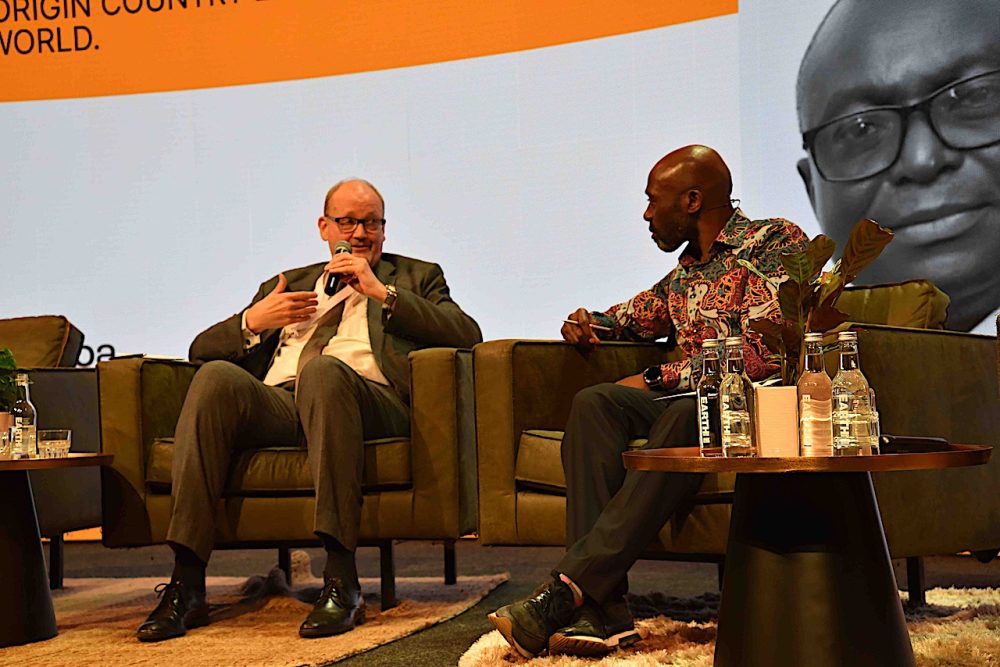
He commented: “There are many burning issues – we have been talking for years about supply and production- too much cocoa, low prices, and making it difficult to achieve a living income for famers.
“The most burning issue now is demand (for cocoa) – which is low – what we use as demand from an ICCO point of view is that we are talking about indicators for grindings, and how much is processed into semi finished products, but you can have a different level with that aspect compared with the level of final demand from consumers, noting that cocoa was often purchased up to 18 months in advance, meaning that businesses across the spectrum had to have a medium-to-long-term perspective in their operations.
He added that the explanation for falling demand was in that brands have in recent years and months changed recipes, reducing the amount of cocoa used. In addition, the size of many chocolate tablets has been reduced,

Major farmer concerns
Similarly, Lawrence Attipoe, UN International Trade Centre Africa regional coordinator, revealed that there has been considerable levels of concern from farming communities in West Africa, in light of decisions just last week to cut farm gate pay by nearly 30% compared to prices last year, as cocoa prices continue to plummet on international commodities markets.
Attipoe said: “What is a burning issue at origin level is that you feel a lot of uneasiness among farmers from such a huge percentage of the producers in Ivory Coast and Ghana. In Ghana, in the past week or two, we have seen a strong farmer force – peaceful but powerful at their unhappiness at the state of play in the industry today. It’s important to put it in context to other economies.

“In Ghana, we have about 880,000 smallholder farmers, with around an acre of land and to further understand it, there are around 6-7 million people depending on only one crop. This is a dilemma socially, and economically, and for the government,” he reflected on the situation.
Furthermore, he explained that the major issue of the government-linked Cocobod organisation not having paid farmers since last October in some instances, had caused real hardship.
He observed that authorities had now responded at government level, stating an intention to address the lost pay, and also tackle the models of financing of the industry, which many observers have identified as a key issue that has resulted in major pressures on the sector amid volatility of prices that has been witnessed over the past two years.
The panel was asked what could make a difference to the future stability of the sector. Arrion asserted: “We want the industry to be sustainable – we must have a limited number of people around the table, we have a few companies representing a large portion of the market – the balance between supply and demand, and looking at means to reduce volatility, which nobody likes. The thing we have seen in the past two years was those crazy prices – we need a reasonable price to ensure supply and demand are matching. We can’t fix the prices, but can agree on ways to achieve continuity,” adding that cocoa should not be seen as the only solution for a living income. He believed that in some cases, diversification of farming crops offered potential, with other agricultural offerings including vanilla and spices.
Moreover, as Lawrence Attipoe conceded, there had indeed been significant pressure on cocoa crops – which are in the top three exports for the two West African countries.
He concluded that with the introduction of EUDR regulations on deforestation, there will be even more pressure upon how land is used, which he believed would prompt a high level of demand for additional farmer training in how smallholders could maximise earnings with alternative crops including pepper, and cassava, though he noted that cost benefit analysis would be required on such initiatives to establish if they were viable for specific locations.

In the second major panel of the day, senior business leaders were invited to explore the impact of higher prices and sustainability issues on consumer demand and the challenges of adapting to an ever-evolving regulatory landscape.
Julia Buech, senior analyst Rabobank, reflected on the striking shift in cocoa prices in recent months that has deeply unsettled market conditions and led to a crisis unfolding with the sector.
She said: ” The cocoa rollercoaster is really playing out in the chocolate market, what’s happening to demand – there was a dramatic rise, volatility, and most recently a collapse. if we look downstream, chocolate prices on shelves, it’s different, and chocolate prices have gone only one way, and that’s up. In western Europe, prices, have gone up 50% since 2021, that’s a big shift. We’re now going to a period of stabilisation, but that doesn’t mean that prices will come back down,” adding that some household brands have been struggling to navigate those fluctuations, while private label has gained market share as consumers facing uncertain economies have resorted to seeking out more bargain-based confectionery and snacking options.
As the analyst noted, there was in fact a widening price gap between what household brands are offering and the private label sector – which had seen growth from 8% of supermarket SKUs to 12% in the past couple of years.
Buech added: “On the brands side, we have seen companies look at reformulation, with cheaper fats and fillers, but even small tweaks can have an impact in taste and texture, with brands such as pladis dropped chocolate from its Penguin and Club biscuit brands,” adding that it would be an intriguing question as to whether consumers either notice or care – but given that the brand has been heavily discounting these lines, it appears notably sensitive to the key change in its sourcing and recipe policies.
In addition, she observed the emergence of other alternatives, but believed the market for lab-grown cocoa remains small at present, but as our title has observed, there are a small core of businesses around this disruptive segment that could potentially see significant growth in coming years within some areas of the industry.
Sector heritage
For his part, Francesco Tramontin (below), vice president of global public affairs and European government affairs at Ferrero, reflected on the growth of the business from its challenging post second-world war origins.

“If we look at how Ferrero has approached volatility, it has been about building opportunities in a pressure situation. When the company started out, there was no cocoa available, nor was there any sugar, but a few years down the line, Nutella was born.
“It was born out of an idea to blend hazelnuts and cocoa and make it affordable – there are many companies formed 60 years ago – if you run a business like ours and look upstream, it’s mostly about risk mitigation and irks management – that’s not a bad thing, it’s a big part of doing business but it’s not the part that generates growth,” adding that there was awareness that chocolate consumption levels were stalling, though there were more optimistic signs for sweet packaged goods markets.
He added: “As for the way taste is shifting, there’s a push for nostalgia in looking for treats. This is a great opportunity for cocoa, as well as those looking for less sweet products. Even on topics of nutrition, there’s a whole lot of things that are damaging for our business and in cocoa, but in debates for ultra processed food, we can defend its integrity.”
Adding to the debate, Gary Guittard, CEO of US-based Guittard (pictured below), offered a perspective of having spent decades working in the sector, observing that structural challenges are nothing new.

He explained: ” The industry has had many challenges through the years, that have presented many problems. The way it has responded – don’t want to paint too bleak a picture, I guess, flavour has value.
“We can talk about alternatives to chocolate, such as cell grown chocolate, I tried some and it didn’t taste very good, but in the future, it could be something to add some of the elements we seem to be losing the cacao diversity that is diminishing.
“I look at the last 50 years of experience, these little changes that take place that you don’t see – I call that incremental degredation, small changes that are happen in the growing regions that year to year, it’s like watching grass grow.
The chocolate we taste today doesn’t taste anything like it did 50 years, ago the industry uses less diverse range of cocoa than it does now. Each brand had a secret formula that meant they tasted different and had a set of consumers that liked that. The cocoa market did the same thing – in inflationary terms, it went higher than it did now,” adding that there was considerable pressure and competition among many companies, especially larger international firms that revolved around shareholders.
He cited significant evolutions over time, such as the picture in Ecuador, which was noted for its final flavour floral beans (Ecuador Nationale), which has become increasingly rare to find, while other variants such as CCN have emerged that are not considered to be as strong, yet are more commercially easy to harvest, noting that there was ‘the perfect storm in West Africa’ where companies were demanding higher yields, which had driven them to use certain more commercial strains of cocoa.
Adding to the debate, Rachel Jujovic, global sustainability director of the Aldi South Group of supermarkets, explained that the retail sector had been following developments within cocoa, though it did not have the level of inside knowledge that those actively trading in commodities held.
She said: “We are making efficiencies, but for for the longest time our sustainability requirements were on standards. No we are looking at the volatility that is going on, though we have limited insights into those pricing dynamics, but we are not unaware of the pressure on the whole value chain, and interventions that will be needed on farms.”
Biodiverse cocoa landscapes
Among several afternoon sessions was one themed on biodiversity across the cocoa sector, and how companies will engage with the CSDDD corporate due diligence legislation which requires action at scale to report nature-positive outcomes within the sector.
As our title has previously covered, major businesses around the world in the confectionery sector have increasingly focused on their overall sustainability policies, with consumers playing a pivotal role in driving meaningful change in terms of standards of operating around the world across industries.
Jorge Leon, B2B sustainability manager for Colombia’s Cordillera Chocolate, spoke on behalf of the company, explaining its efforts to proactively engage with programmes supporting a diverse array of wildlife across its home nation.

The Cordillera Chocolate team spoke at this year’s WCF meeting
He said: “Agroforestry is the baseline. It is where biodiversity is in balance with forests and nature, and actually it works. What monocultures are constantly showing to us that while they might work in the short-term in terms of yields, in the long term, they aren’t going to be balanced, not only with nature, but for entire ecosystems.
He added: “Colombia, where we are based as Cordillera Chocolate, is super strategic as a location, it is one of the mega diverse hotspots on the planet, and this is absolutely strategic for the cocoa business as well.
“We are the number one country with bird species on the planet, and for amphibious species, and are second for flowers and reptiles, and the top five for mammals in the planet – that means that Colombia is a global hotspot where we can work together. We have heard a lot here over the past 48 hours here about collaboration, and we can work together on systematic risk management towards both businesses and nature.”
- A complete extended report on the WCF partnership meeting can be found in the next edition of Confectionery Production magazine.