Exclusive: Luker Chocolate shares its industry vision with the World Confectionery Conference

With our World Confectionery Conference fast approaching this September, we feature an exclusive interview with one of its keynote speakers, Colombia’s Julia Ocampo, vice president of cacao sourcing and sustainability, on major tests facing the industry. Neill Barston reports
Having the vision and determination to make genuine and tangible gains with sustainability is something that requires considerable investment of time, resources and energy.
While the wider confectionery sector has raised the prospect of improving conditions for farmers operating at the sharp end of the industry for some two decades, Colombia’s Luker Chocolate is among those that have really “walked the talk” in its operations.
As anyone working within the global environmental sector will acknowledge, there are few fast solutions to be had in the long-term goal of addressing key global topics of deforestation, child labour and delivering advanced agricultural practices that drive meaningful change for the sector and the lives of those who are its heart. Indeed, as our title has covered over the past year, the major crisis that has gripped the cocoa sector in terms of its environmental, social and financial challenges for communities have made scaling up industry-wide solutions even more existential priority.
For its part, Luker has set out a clear path for making core gains with its “Chocolate Dream” initiative that has placed everything from enhancing farmer pay, through to management and enhancement of cocoa crops right at the core of its mission.

Julia Ocampo of Luker Chocolate will join our World Confectionery Conference in Brussels as a keynote. Pic: Luker Chocolate
Consequently, the business duly gained a significant sustainability accolade at our World Confectionery Conference in 2024, recognising the clear passion throughout this forward-thinking confectionery B2B supplying business.
As we have previously reported, the company has forged relationships with a wide array of SME companies around the world, including British companies such as Sweetdreams Ltd, Love Cocoa and Hames Chocolates to name a few. Indeed, the company that started out way back in 1906 based around its core founding range of hot chocolate series that remains a traditional favourite of the nation, has for more than a decade expanded its export focus into premium chocolate bar series.
Its core mission purpose was underlined in achieving coveted B-Corp status two years ago that has cemented the progress it has continued to make in upholding its environmental performance and aspirations for delivering wider social improvements.
As Julia Ocampo, Luker’s vice president of cacao sourcing and sustainability explained to our publication, she is keenly anticipating playing her part of our upcoming edition of the World Confectionery Conference as it makes a significant return to Brussels this autumn, on 11 September. She will be joining a diverse gathering of industry experts representing the entire confectionery value chain as has previously been firmly the case over the past four years.
This year’s contributors to our showcase that place core topics of sector sustainability, innovation and new policy developments in the spotlight includes Caobisco European trade association, the Ferrero confectionery group, Fairtrade Foundation, well as ingredients businesses Alland & Robert and Corbion, Palsgaard, as well as crucial insights from Euromonitor International and Mintel.
“I’m so happy to have the opportunity at the conference to speak about what we are doing in Colombia, where we have worked hand-in-hand with farmers on our field projects. “It is very nice that we will be able to share the real impact of what is being achieved for families in our country, where we are aiming to work with a total of 5,000 families by 2027,” enthused Luker’s sustainability expert on how the company is gradually scaling-up its operations.
While she explained that the business has strived to continue its mission, there still remain a number of remaining industry tests within the company’s home region. These include tackling ongoing issues of struggling cocoa yields, as well as crop disease and a need to update rural farming practices to meet ever-increasing international supply demands.
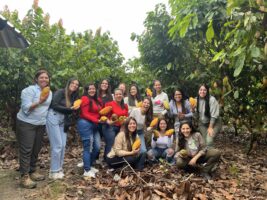
Luker Chocolate has just released its latest sustainability report. Pic: Luker
As Julia asserts, its targets are “not just a number, but real relationships that we have with families and our broader ecosystem,” in terms of how it perceives attaining tangible industry-wide improvements. While Colombia’s challenges may in part from other cocoa growing territories in the form of West Africa’s Ghana and ivory Coast, there ae are clearly many commonalities faced by the global market. Notably, as Luker has detailed, some areas of its home nation have also suffered from economic instability.
This has affected their ability to deliver resilience against market uncertainties, such as those that have loomed large on the horizon at present. As for geopolitical matters, ongoing wars in the Ukraine and Gaza have significantly affected supply chains for many of its customers, as well as significant wider increases in ingredients including sugar. This has contributed to further market uncertainties, with pressures on many countries’ economic budgets posing a real test to their resilience.
There have also been the related issues of wider soaring cocoa prices that have unsettled market conditions on a global level, with reports of supply deficits on an international level.
Despite such issues, Luker remains steadfastly committed to its mission of delivering sustainable sourcing infrastructure for the industry, and as Julia enthused, helping drive positive change has proved a strong motivational force for her since an early age. She explained: “Though I grew up in a city, we were a cocoa and coffee family, and we had a farm around 25 minutes from where we lived. I loved working together with those people on the farm and trying to understanding that those families had different problems that are often difficult to explain to the industry.
“That’s what made me want to study sustainability, which I did in Versailles, France, studying an environmental masters degree. I always had the idea that I wanted to work back in Colombia with those coffee and cocoa farmers to develop practices that the industry needs, as well as examining their wellbeing,” added Julia, who also holds a degree in industrial engineering, and has now built-up a total of two decades of experience working within the sustainability sector.
Annual report success
As Julia elaborated, since joining Luker Chocolate a number of years ago, she has seen the business make considerable strides. Among the most notable of these have been the positive gains has been delivered in its annual report, including progress on core sustainability targets on supporting farmers with enhanced pay, traceability and environmental practices.
As its latest report asserts, as of October 2024, all Luker exports to Europe met compliance with EUDR requirements to prevent deforestation in its supply chains – which exceeded the deadlines for the legislation which had been set to enter force at the end of last year. However, in the wake of political and industrial lobbying to the EU Commission, as well as technical issues surrounding the implementation of the major legislative framework, businesses have been allowed an extra year to meet the new standards.
These will for the first time make it mandatory for companies to demonstrate that supply chains are deforestation free. Furthermore, it appears on track to reach its target of working with 5,000 farmers, with the company presently working with 4,320 families that are experiencing an improved quality of life through education, rural entrepreneurship, and human rights enforcement. Moreover, in terms of directly improving its emissions as a business, Luker has attained a 22 per cent reduction on scope one and two in energy and industrial carbon emissions, which represents another core element of its strategy.
In addition, the company’s status as a B-Corp enterprise, operating to enhanced sustainability standards has also proved pivotal to its overall approach, and is continuing to yield positives for the business across its various elements. As Julia noted in the report, last year had been a year of having to continually adapting to challenging market conditions.

Luker Chocolate has just gained B Corp status. Pic: Luker
These tests peaked with the comparatively high cocoa prices that soared to $12,000 at the end of last year, and remained at that figure into the start of this year, though have since slowed a little in recent weeks. However, wider sector volatility remains, which the sustainability specialist noted had made it more significant than ever in terms of backing its core farmer network through paying 103 per cent of the market price. This has reportedly had a profound positive impact on communities with which it deals in Colombia, that has seen incomes being tripled.
Consequently, in spite of such background challenges, the company delivered one of its largest harvests, totalling 73,000 tons. In her analysis, the sustainability director commented: “This year made it clear that, despite volatility, we share a common purpose with our clients, partners, and suppliers: securing the future of chocolate. Uncertainty highlighted the importance of the collaborative approach we have always prioritised, reinforcing our focus on long-term sustainability. “Through The Chocolate Dream, we supported over 4,300 families, reinforcing our commitment to shared value at origin and carried out 27 active projects directly impacting communities across six regions in Colombia. Investment reached six per cent of our earnings before tax, and for every $1 committed by Luker Chocolate, an additional $1 was leveraged in value through the support of local and international allies, as well as clients actively participating in the Dreamers Club.
As a proud B Corp-certified, we firmly believe that for our business to be sustainable, the entire supply chain must be as well. This year, we had to make adjustments that tested our resilience and challenged us to innovate, always with the goal of protecting both the communities we work with and the commitments we have made to our clients,” stated Julia, who firmly believed that it is making good on its pledged to make a difference for cocoa farming families. Crucially, she added that one of the best means of achieving further success in its plans is in leading via example.
Furthermore, she enthused, this is being actively achieved through its own cocoa plantations, which it has used as a template for independent family businesses to take sustainability inspiration from. Significantly, Julia added that via its own farm, as well as educational outreach through the Luker Foundation, it is continuing to have a positive impact on the region’s cocoa industry. Another significant aspect of its work comes in ensuring a consistent level of quality premium cocoa supplies.
Moreover, as any student of the sector will be aware, Colombia retains a well deserved reputation for the quality of its crops, which the business is eager to maintain and enhance. According to Julia, there are several core reasons for the strength of its cocoa, including the relatively resilient nature of its cocoa varieties, as well as its land terroir itself, with many of its agricultural areas being rich in biodiversity, which also adds to the sector’s strength. “The thing that is different about the Chocolate Dream is that we don’t just work with farmers, we also include communities as well, who may find that they are sparked into joining the industry.

pic: Eugenia Jimenez farming for Luker Chocolate in Colombia. Pic: Luker
“We share all our reports – whether they are good or bad, as this is a way of learning and building trust with people, through proving our actions and we will can share how sustainable practices are done, which is how it has worked for us,” reflected Julia, who asserted that working with governments and civil society in tackling wider environmental and social issues has been of considerable importance.
This is especially the case in terms of encouraging the industry’s next generation of farmers to join the cocoa world, which remains a deeply fascinating and engaging industry to be connected with. But as with many other areas of the globe, encouraging the nation’s youth to take up agriculture has posed its tests, given that it has not necessarily seemed an attractive option for many young people who often seek out urban employment opportunities in preference to traditional agricultural work.
However, as companies such as Luker continue to find success as a business in driving exports and delivering social gains for the industry, there’s a growing sense of optimism that the industry can thrive for the medium and long-term. “It’s been not only a passion for me to be working in sustainability and for creating chocolate which is of course very good, it’s also about what we see every day, and that is happy families. Sometimes we say that we work for smiles – when you see a parents happy with their work, as well as helping kids going to school through our Luker Foundation, and this is where we can see that we’re making an impact,” added Julia.
She has been especially heartened by the fact that farmers are becoming increasingly savvy on climate issues and ensuring that preserving landscapes and earning a living are not mutually exclusive and that being a custodian of a longstanding industry is something that the region remains particularly proud of, even amid notable market challenges. Through a spirit of collaborative working, the company is playing its part in helping support and inspire the sector’s continued development.
- This year’s World Confectionery Conference is being staged on 11 September 2025, where Julia Ocampo will be among keynote speakers. Register at confectioneryconference.com For commercial exhibition and speaking enquiries, contact Chris Meer at [email protected]
Topics
chocolate cocoa Colombia community engagement confectionery ethical sourcing policy strategy sustainability
OrganisationsRegions