
Luker Chocolate celebrates b-corp status sustainability recertification
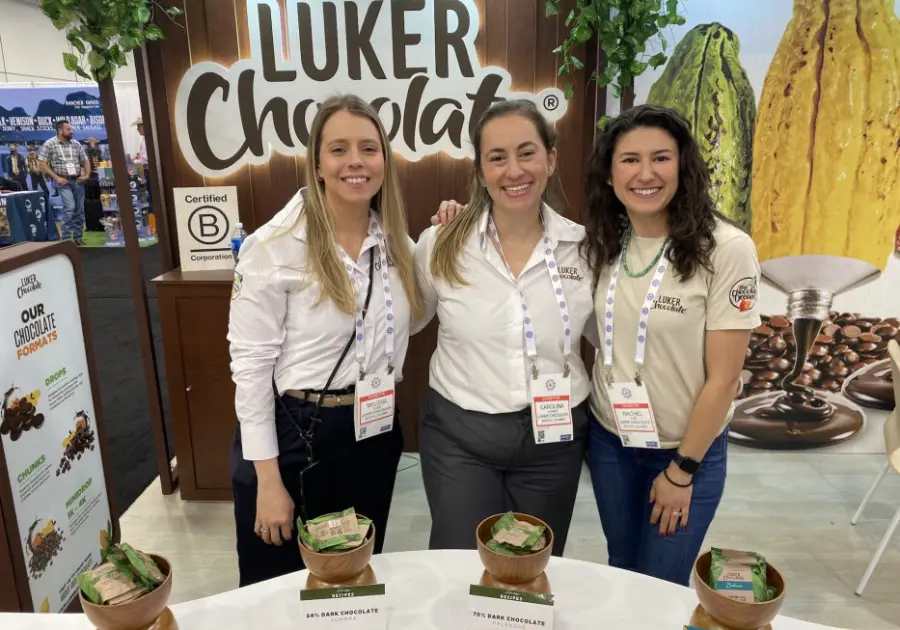
Luker Chocolate's team was recently at Sweets & Snacks Expo recently in Las Vas, and continues its 120th anniversary at the London Food & Drink Festival. Pic: Neill Barston
Colombia’s Luker Chocolate business has celebrated becoming re-certified as a b-corp company, after enhancing its overall sustainability standards, writes Neill Barston.
The B2B chocolate supplier, which has worked with a wide array of manufacturers operating across the global industry, from small independent firms, to larger producers, has asserted that its freshly-renewed certification standards represent a key leap forward for its operations.
Notably, the company, which was among major presentations at last year’s World Confectionery Conference, has continued to place a strong emphasis on traceability of its supply chain, as detailed at our event in Brussels in 2025.
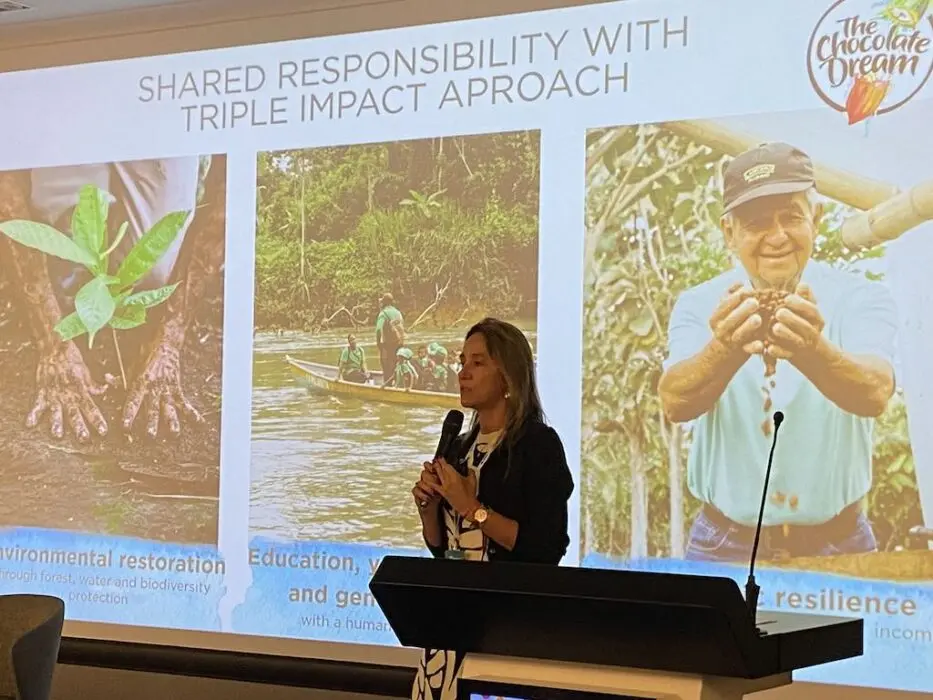
Luker Chocolate presenting at last year’s World Confectionery Conference. Pic: ell Publishing
As the company noted, the recertification under B Lab’s new standards reinforces the way the firm manages social, environmental and governance impact across our business and value chain.
Implementing compliance
Speaking on the upgraded changes, Catalina Gomez, sustainability lead for Luker, believed the new status would have a significant impact in how its evolved its policies.
She explained: “The previous B Impact Assessment worked on cumulative points. A company moved through 5 impact areas — governance, workers, community, environment, and customers — accumulating a score, and 80 points was the bar to clear.
“The new standards replaced that logic. There are no points to accumulate. Instead, a company has to meet defined performance requirements across a broader and more specific set of impact topics: purpose and governance, fair work, justice, equity, diversity and inclusion, human rights, climate action, environmental stewardship and circularity, government affairs, and collective action that reflect today’s sustainability landscape with a significant upgrade.
“The difference matters more than it looks on paper. Under the old system, a company could ask: what practices do we have, and how many points do they earn us? Under the new one, the question is: how are these impacts structured, governed, managed, and evidenced? Policies, clear owners, resources, KPIs, risk management, and proof of implementation now sit at the centre of the assessment.”
As she further explained, one of the most significant elements of its approach has been in adopting formal standards, rather than it being a reactive initiative with a generalised standard.
Indeed, as the company has previously explained, it had been especially keen to further its sustainability agenda, which is something that had been a natural part of working since the company’s earliest days.
Moreover, as Confectionery Production has previously covered, the company, which started out primarily delivering drinking chocolate intended for a domestic audience, has continually evolved into wider chocolate bar production in recent decades, that has seen it continue to make strides in wider global markets.
Catalina Gomez continued: “Under the old framework, having a strong initiative — a diversity programme, a supplier development project, an environmental commitment — could carry weight on its own. With the new one, the initiative is the starting point, not the deliverable. What has to follow is documentation of how it’s governed: who’s accountable, what budget sits behind it, what risks it manages, how it’s measured, and how it feeds back into decision-making.
“We’ve had to be far more specific about the system of commitment behind each thing we do,” Catalina put it. “The new standards require greater formalisation of policies, processes, and documentation, with clearly defined cross-functional responsibilities, approval mechanisms, and active participation across teams to ensure organisational ownership and accountability,” which she added had now seen this strategy become a company-wide requirement, rather than being something led by its specific sustainability teams.