Exclusive: Fairtrade Foundation CEO Eleanor Harrison doubles down on its mission

Eleanor Harrison is set to take up her post as the new CEO of Fairtrade Foundation in March. Pic: Fairtrade Foundation
Fighting for better conditions for agricultural workers, including in cocoa, remains at the heart of Fairtrade Foundation’s mission. Editor Neill Barston speaks exclusively to its CEO, Eleanor Harrison, ahead of the organisation’s 2026 World Confectionery Conference appearance.
The key social justice movement will be represented at our or event on 10 September in London by Jason Archie-Acheampong (below), cocoa sourcing specialist, following his key appearance for our global gathering last year in Brussels, discussing major challenges that continue to impact across the international sector.

Jason Archie-Acheampong, of Fairtrade Foundation will be among participants at our World Confectionery Conference. Pic: Fairtrade
In our previous edition, Jason put across the level of engagement that Fairtrade has continued to progress in core producing nations in West Africa, which remains at the heart of the supply chain for the global chocolate confectionery industry.
Notably, the topic of cocoa supplies will take centre stage once again among wider sustainability reflections at this year’s event, with registration remaining open for our 2026 showcase via our dedicated website at confectioneryconference.com
For her part, Eleanor Harrison, who is among special guests at our event, has gained a strong track record within the nonprofit sector, including roles helping improve social outcomes and scaling impact for young people facing disadvantage. Watch our exclusive video version of the interview below.
Notably, as our title previously covered, in 2016, Eleanor received the Order of the British Empire for Services to International Development. In her role as Chief Executive of online platform GlobalGiving UK, she utilised her entrepreneurial drive and commercial acumen to disrupt traditional aid and accelerate community-led change.
Eleanor has also held several leadership roles in international NGOs, including running a Kenyan NGO for five years supporting children and their families to build better lives for themselves.
Q: How have you found your first 18 months with Fairtrade Foundation?
A: I think the thing I’m enjoying most about the role, having been a Fairtrade
supporter for over 30 years since the beginning, is the opportunity to be directly involved in a market-based solution. This includes giving workers better conditions, and climate support through our everyday consumer actions. So, I love that part of it, and the direct fair trade principles. I’m extremely fortunate that I have the commercial side that I am
responsible for, but I also have the movement aspect, and so I have thousands
of phenomenal people around the country forming Fairtrade communities, places of worship, schools and universities, who are leaning in to say, ‘how do we build a fairer system together?’ I think that community movement, and that working actively with business partners is a real joy, and that’s my job in running the Fairtrade Foundation. The fact we’re 50 per cent owned by farmers
and workers, means there is constant meaningful dialogue from them.

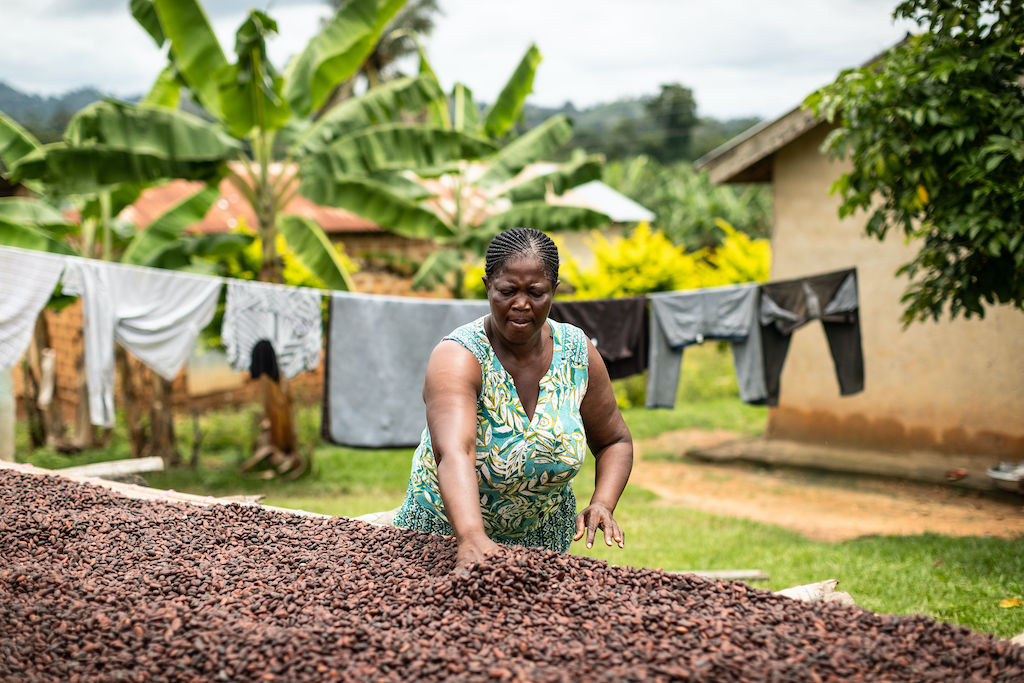
pic: Cocoa Farming in West Africa. Pic: Faritrade
Q: Fairtrade Foundation is returning to the World Confectionery Conference, how do you feel about that?
A: I am delighted that my colleague Jason Archie-Acheampong, who is a superb speaker and thought leader on cocoa, will be on the conference sustainability panel. I would encourage people to register for the
event, and think it is really important for us to come together and have frank and honest discussion about the challenges we face, because no one has the solution on their own, and that includes Fairtrade. It is about genuinely working together and thinking about that ultimate purpose that we all want to enjoy the products that we love in 10-20 years’ time, and that requires change.
Q: In taking on the role of CEO, was this something that was a sense of calling?
A: I have been fortunate to have had a 20- plus career in the non-profit sector. What really attracted me to this role was that the mission is around putting power and agency in the hands of farms and workers to live life on their terms. So, it’s not about giving a helping hand; it’s about like making global supply chains fairer, and so what drew me to the role was the opportunity to try and
deepen long-term partnerships with business. I was really attracted by the
overall movement – it is fortunate to come into an organisation that has the most trusted ethical brand status in the world. But I wanted to take it further, I wanted to renew that brand, and make sure that we were connecting with new audiences, and then the idea of trying to normalise fair trade. So yes, we have been really successful in what we’ve done to date, but we’re in a complex world that is volatile. I was also attracted by the opportunity to look to the future and think how, with other stakeholders, do we re-imagine trade to truly make it fairer? So those are some of the reasons that I took the job.
Q: What were your working experiences like before joining the Fairtrade
movement? A: I am very fortunate to have had a varied career. I started out in the refugee sector, and that gave me really early exposure to working with phenomenal people from different cultures and backgrounds, and some of the complex environmental and political conflict situations in the world, and how that is affecting people. I was then really fortunate to run an organisation in Kenya for five years. In addition, I’ve worked quite closely with a lot of tea and coffee people, as well as sugar, and that really gave me early exposure to the decisions people make and the challenges they face. I was working with children in vulnerable situations, but that was probably my first foray into looking at economic solutions. Rather than trying to purely help people go to school by buying school uniforms, it was more about what can you do to make sure that they have money, and how businesses support themselves, and this is something I’m really excited to bring to Fairtrade. When I was in Kenya, I ran a tech for good platform for a number of years, called Global Giving, and that was all about ‘disrupting philanthropy.’
pic: Fairtrade
Q: What do you believe are some of the keys to helping communities unlock greater financial potential?
A: I believe that long term partnerships are crucial. I think that is particularly the case when you take into account the necessary investment that is required for climate resilience. We can’t be in an environment where we are changing suppliers every 12 months for short-term commercial gain, we all lose. Businesses lose, the consumer loses and the farmer absolutely loses. You don’t get the necessary investment. Some of the work that we are doing at the
moment is around those long-term partnerships. So, that is a question of shared impact, which is based on collaborative sourcing to enable people
to buy greater share from a smaller number of producers, so that you can
unlock much greater investment for productivity and environmental gains.
Also, Marks and Spencers has been really crucial to that pilot, and that has further evolved into our global living income work. Bringing businesses and producers much closer together is our goal, which is what we’re doing with Sainsbury’s, through the Resilience Building Initiative.
Making sure that you have got that genuine, meaningful stakeholder dialogue
when your traders and your retailers are making those commercial decisions, is also important.
I think co-operative strengthening is a also a must, as when you have such huge power differentials, the evidence is very compelling. So, bringing them together and doing that further investment and making sure they’ve got the necessary access to finance on fair terms is really prudent. Furthermore, you can also never ignore pricing either, and that is the reason we have a Fairtrade minimum price.
Topics
chocolate cocoa confectionery fairtrade farmer pay legislation supply chains sustainabiity World Confectionery Conference
PeopleEleanor Harrison Jason Archie-Acheampong
OrganisationsRegions