Exclusive: Lidl withdraws chocolate linked to Tony’s Chocolonely ‘copycat’ claims
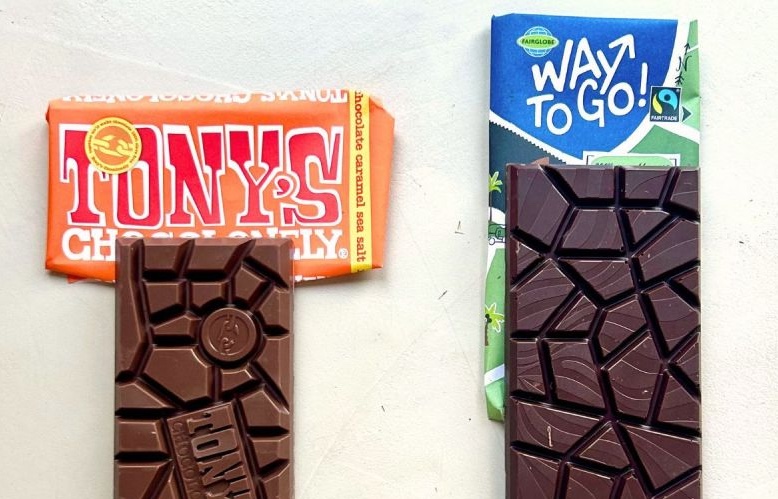
Tony's Chocolonely has previously asked Lidl to adpot its five sourcing principles in light of the retailers similarity to its own bars. Pic: courtesy of Will Poskett
An alleged ‘copycat’ own-brand chocolate bar from Lidl that has drawn criticism from Tony’s Chocolonely’s flagship confectionery series over design similarity, has quietly been withdrawn from British shelves, reports Neill Barston.
Notably, the German-founded supermarket first released its ethically positioned Way To Go series back in 2020, with a direct link to Fairtrade that had asserted its sustainability credentials – and contends that its decision over removal of the bar in the UK is not linked to any competitors’ products.
However, its own-label brand has been under fire from Dutch created impact brand Tony’s Chocolonely, which was originally forged over two decades ago on its mission to ‘deliver a slave free chocolate supply chain’ – having taken issue with the major retailer’s rival bar developed with a strikingly similar design concept of unequal pieces. This has been disputed by Lidl, which confirmed that the brand is continuing in its other European markets.
For its part, Tony’s design has been a crucial founding element of the Netherlands business, which long asserted that its unusual design represented the inequality that exists within the wider production chains of the industry.
The company reportedly did not seek legal redress from Lidl and instead urged the supermarket to adopt its five founding principles of sourcing, based upon ethical trading – but the retailer has insisted that its decision to alter British chocolate bar ranges is not in fact related to any other brand.
Bars dropped from stores
Notably, the Way To Go Chocolate series has been quietly dropped during this year, which was confirmed by a spokesperson from Fairtrade, who stated that it was unable to comment further on the case.
The issue is not the first incident for either company – with Lidl being forced to destroy its own-brand ‘Golden bunnies’ that were legally judged to have copied Lint & Sprungli designs in 2022.
Meanwhile, Tony’s Chocolonely found itself being forced to change packaging in German markets, after a court ruling that its designs of certain products were too close to those of Milka chocolate bars – though there was no issue over the physical design of the product.
As for the latest saga with Way To Go Chocolate, it has continued to attract notable attention in recent years, including fresh analysis from branding specialist Will Poskett.
In a social media post on the topic, he asserted that Lidl’s move in developing a bar that bore significant similarities to Tony’s Chocolonely’s flagship offering did not represent a strong commercial move.
Speaking to our title, he said: “Lidl has borrowed one of Tony’s Chocolonely’s most distinctive brand assets, but without the meaning that made it distinctive in the first place. Tony’s uneven chocolate pieces aren’t simply a design choice; they represent inequality within the cocoa supply chain and connect directly to the brand’s mission. That’s incredibly difficult to copy authentically.
“There’s also a strategic risk for Lidl: when you imitate such a recognisable challenger brand, you can end up advertising the brand you’re copying rather than building your own. Lidl has a brilliant history of cheekily taking on established brands, but this feels different. Imitation might be the sincerest form of flattery, but it’s rarely a great brand strategy.”
Confectionery Production has approached Lidl for comment on the case, at it has responded that the brand is still active within some of its markets, and the decision to alter that in the UK is was not due to any external factors.
A spokesperson for Lidl GB said: “We regularly review and update our product ranges to ensure we are giving our customers the best selection of affordable, high quality products. 100% of our own-brand block chocolate continues to be Fairtrade Certified and we remain fully committed to ethical and sustainable sourcing across our cocoa supply chains.”
The Way to Go brand has extended out into other areas, including most recently within the tea market, with the company stating it had plans to expand in Europe with other key ingredients in its supply chains, with the company noting that its chocolate bar has been retained in other areas of the business.
In a statement on its website, Lidl noted: “From mid-2026, we will pay the Fairtrade’s living income cocoa programme across our entire permanently listed private label chocolate bar range in five countries. The rollout began in Germany, the Netherlands, Belgium, Luxembourg and Austria. Our commitment is set for a minimum of five years, regardless of market fluctuations.
“With the Living Income Programme, we are going beyond our existing Fairtrade standards and setting new benchmarks. Instead, we want to make a significant contribution to closing the income gap for cocoa farmers in participating cooperatives in Ghana and Côte d’Ivoire – in a measurable and long-term way. As one of the major purchasers of Fairtrade cocoa in the food retail sector, Lidl uses this scale of volume to support measurable adjustments in upstream supply chains.”
Tony’s Chocolonely has also been approached by Confectionery Production for further comment on the case. In a statement, it added: “Our message to anyone making choco is you can have our secret recipe: for chunking good chocolate AND for fighting exploitation in cocoa.
“We give it away to any cocoa-sourcing company that wants in, ‘cos we’re an impact company that makes chocolate, not the other way round. And Lidl, if you ever fancy joining Aldi, Waitrose, Ben & Jerry’s and more as a Mission Ally, we’d love to chat. Our door’s always open.”
- Brand specialist Will Poskett’s newsletter can be seen at defiantagency.substack.com
Topics
chocolate confectionery copyright fairtrade legal cases manufacturing sustainability
PeopleRegions