Ghana’s Cocoshe cocoa group calls on government to tackle reported farmer payment crisis
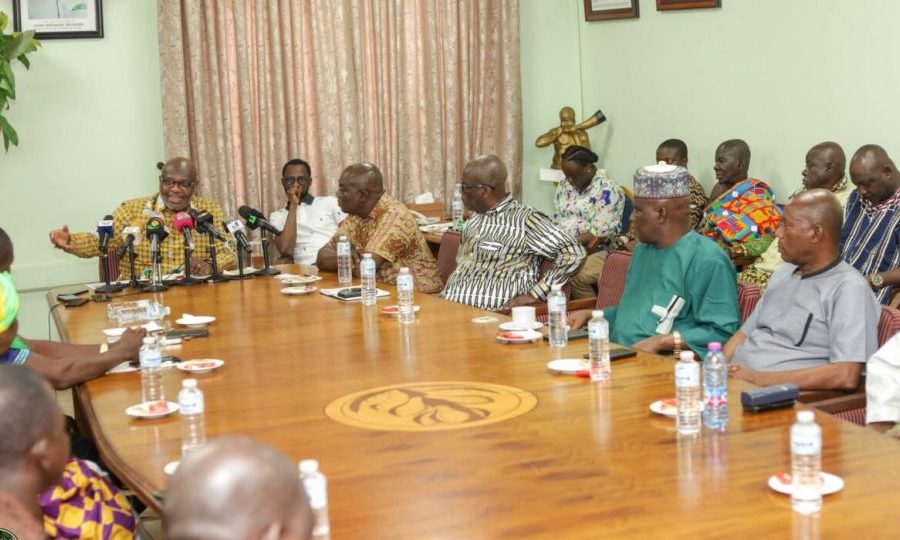
Ghana's Cocoshe organisation is calling on the government for action over a reported farmer payment crisis. Pic: Sam Poku
The Ghana Cocoa, Coffee, and Shea Nut Farmers Association (COCOSHE), has responded to an unfolding regional sector crisis, delivering a stark appeal to the government, to urgently resolve debilitating delays in cocoa bean payments, writes Sam Poku, and additional reporting from Neill Barston.
Significantly, the group, which is understood to be the longest-running organisation of its kind in the country, speaking through its National Chief Farmer and President, Alhadji Alhassan Bukari, has called on agricultural workers in the region to back its calls for action on the issue that has placed significant strain on communities.
Confectionery Production has approached Cocobod, Ghana’s governing organising the region’s cocoa industry, but as of the time of writing, no response has yet been forthcoming.
Cocoshe expressed deep concern over the prolonged hardship inflicted upon its members, the backbone of Ghana’s vital cocoa industry – as reports emerge via the international Reuters agency this week that delays in farmer payment are causing hardships within agricultural communities, with increasing volumes of cocoa going unsold in the region.
Confectionery Production has been unable to verify the extent of the issue, but the latest crisis comes in the wake of major price volatility in the past 18 months, with crop prices commanding $12,000 a tonne on futures markets in New York and London throughout 2024. These prices persisted until the start of last year, when they began to dip, with prices now fetching less than half of the $12,000 peak (at under $5,000 a tonne).
In response to high prices in 2024, Ghana and Ivory Coast authorities have continued to pay at elevated levels seen from the middle of last year (which were still significantly below what commodity prices were), which has reportedly made the situation non-viable as the global value of crops continues on a downward spiral.
Another key element of the issue relates to an issue raised by Reuters in its coverage, which asserted that authorities in the region were experiencing potential liquidity problems, amid a situation where previous multi-million loans distributed to both Cocobod, and Conseil du Cafe-Cacao (which oversees Ivory Coast’s market), were no longer operational in 2026, replaced by private finance agreements, though the extent of this claim remains unverrified.
Consequently, COCOSHE has been briefed on the mounting issues surrounding delayed payments for cocoa beans, a situation that has plunged countless cocoa farmers into severe financial distress.
Despite recent negotiations with the Ghana Cocoa Board (COCOBOD) aimed at addressing these payment bottlenecks, the association stated that the problem persists, necessitating a direct plea to the highest levels of government to find comprehensive solutions.
“We are acutely aware of the suffering our fellow farmers are enduring,” stated a release signed by Alhadji Alhassan Bukari. “For months now, many have been unable to meet their basic financial obligations. Their crops have been harvested and sold, yet the expected remuneration remains elusive. This is not merely a sectoral issue; it is a crisis that impacts livelihoods and has widespread repercussions for our national economy.”
The severity of the situation has caught the farmer executives by surprise, highlighting a breakdown in the expected financial flow within the cocoa value chain. For farmers, the delay translates into an inability to purchase essential farming inputs for the next season, cover school fees, afford healthcare, or sustain their families. This precarious financial state not only threatens individual farmer well-being but also jeopardises the future productivity and stability of Ghana’s second-largest export earner.
Major sector player
COCOSHE emphasises that the cocoa industry is a significant contributor to Ghana’s Gross Domestic Product (GDP) and foreign exchange earnings. Any disruption, particularly one affecting the immediate income of thousands of farming households, sends shockwaves through local communities and the broader economic landscape.
The association conveyed that while they appreciate the complexities involved in managing commodity markets and payment systems, the current level of delay is unacceptable and demands immediate and decisive action from the Ghanaian government.
In its statement, the organisation highlighted the critical role of timely payments in maintaining farmer morale and encouraging continued investment in cocoa farming. Without a reliable and predictable income stream, the long-term sustainability of Ghana’s renowned cocoa production is at risk. COCOSHE is urging the government to explore all avenues, including potential emergency financial facilities or a swift audit of the payment process, to expedite outstanding payments and prevent further deterioration of farmers’ financial situations.
While acknowledging the challenges faced by the Ghana Cocoa Board in processing payments efficiently, COCOSHE firmly believes that collective efforts can yield a swift resolution. The association is calling upon the Ministry of Finance, the Bank of Ghana, and other relevant stakeholders to collaborate closely with COCOBOD to unblock the payment channels and restore confidence in the system.
COCOSHE implores all its members and cocoa farmers across the nation to exercise patience during this trying period. The association assures its members that it is working tirelessly with all stakeholders to ensure that normalization of payments will be restored as soon as possible. The ultimate goal remains to safeguard the welfare of farmers and ensure the continued prosperity of Ghana’s Cocoa Sector.