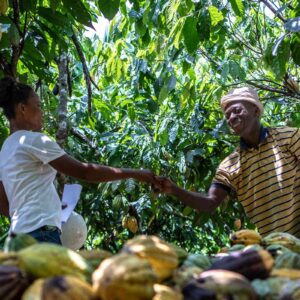
Analysis of Fairtrade strategies reveals key gains for farmers, including cocoa communities

pic: Fairtrade
Independent analysis of Fairtrade’s work around the world including its work on backing farmer pay through premium prices, community engagements has been found to be making continued progress, writes Neill Barston.
The social justice movement, which will be represented at our World Confectionery Conference on 11 September in Brussels for our Q&A on sustainability, has continued to assert that gains are being made in helping drive the major shifts that are required to bring about a living income for workers in key confectionery and wider food sector supply chains.
According to the organisation, the new external study carried out by researchers David Jodrell and Willemijn de Bruin highlighted Fairtrade Minimum Price and its premium payments, coupled with strong Standards and hands-on support for producers were considered of pivotal importance to its delivery of tangible change for farming communities.
As it observed, the “Evidence Map 2021 to 2024: Evidencing the Theory of Change” reviewed 122 different studies, along with Fairtrade’s own programme and monitoring data and focus groups with staff, to connect the activities that it has carried out to results evidenced in research and other data.
The results from the study, which is conducted every four years, will inform Fairtrade’s Theory of Change, which spells out how its interventions create change in the short and medium term, to create long-lasting impact. It will also help shape its agenda for programme development around the world.
“This ‘study of studies’ is a large undertaking that helps us to understand our impact across a range of areas from environmental effects to livelihoods to inclusion to trust and satisfaction,” said Fairtrade International’s Director of Global Impact Dr. Arisbe Mendoza. “It’s important to carry out this kind of work so that we have an evidence-based guide to lead us forward, and also make it easy for anyone to see the difference that Fairtrade makes and to have confidence in choosing Fairtrade.”
Core areas of focus
The research examined core areas including economic benefits of the organisation’s work – examining a wide range of 60+ studies found that Fairtrade provides farmers with greater price stability and resources thanks to mandatory minimum pricing and extra funds from the Fairtrade Premium.
Furthermore, it assert that nearly 90 percent of studies that looked at the longer term outcome of economic gains found at least some positive contribution of Fairtrade, including higher incomes for farmers, improved farm revenues and higher net returns, and greater income stability.
The researchers also looked at 33 studies analysed relating to climate resilience, and discovered that the organisation’s training and support programmes lead to increased knowledge and awareness among producers of issues such as improved farm management and agrochemical application, disaster risk management training and planning, and sustainable farming practices.
For example, farmers are using less fertilisers, pesticides, and herbicides, are practicing soil, water, and forest conservation, and using energy efficient technologies such as solar panels.
In addition, the analysis also looked at 21 studies that showed that the key social justice movement is linked to higher participation by women in cooperatives, gains in gender-focused capacity building, skill acquisition and workforce inclusion, and women’s leadership opportunities, increased economic status, and successful capacity strengthening efforts.
Significantly, the studies also found strong evidence that Fairtrade’s presence on the ground resulted in better working conditions for many farming communities including fairer contracts, health and safety protection, labour rights and legally binding working hours. There was also evidence of greater trust and satisfaction with producer networks.
Another major finding of the analysis of its performance showed that focusing on delivering sustainable, resilient and fairer supply chains had been successful in securing higher incomes for farmers, as well as fostering greater inclusion and greater influence on regional economies through being provided with opportunities that had in many instances not been traditionally available to them within many communities around the world, including within West Africa, which remains central to the cocoa trade.
Dr. Mendoza concluded: ““Fairtrade is one of the most researched ethical certifications out there, which is good for us because it means academics and students are putting their skills to work to measure if we’re having the impact we want, and where the gaps are,”
“We update our research agenda annually and really value the collaborations with researchers and other like-minded organisations – as well as our own monitoring and evaluation staff across our global network – so we can all know more and do better.”
Topics
analysis cocoa confectionery fairtrade Fairtrade premium studies supply chains
PeopleOrganisations