Exclusive: Behind the scenes at Hotel Chocolat

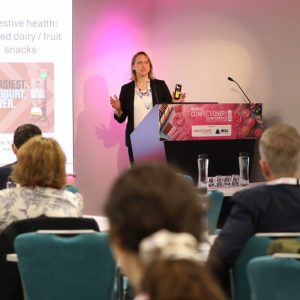
Ollie Hughes, head of manufacturing at Hotel Chocolat, offers a key tour of its production facilities. Pic: Neill Barston
Having grown significantly over the past two decades, Hotel Chocolat is now entering a dynamic new phase of its story, as it continues to evolve under Mars group ownership. Neill Barston gains an exclusive tour of its British production headquarters near Cambridge
Pulling up to the production headquarters of Hotel Chocolat close to leafy suburban surroundings of Huntingdon in
Cambridgeshire, the immediate surroundings aren’t necessarily giving away too much as to what lies ahead. (Catch our exclusive video version of our interview below)
Notably, there’s a neat touch in the form of a factory outlet store to the front of the building, yet it is only when exploring its bustling production halls that you realise there’s something really rather special taking shape across the site.
Significantly, the business is now producing a sizeable tally of more than 200 million chocolates a year from 400 recipes at its Hadley Park location, underlining just how far the business has come in a relatively short period of time over the past two decades.

It’s perhaps no surprise this key manufacturing operation should be based in such a strategically significant site in southern central England, with its operations and ambitions being trained on far further horizons.
Indeed, the wider county itself has garnered an international reputation for its technological prowess, with the area surrounding Cambridge becoming known as Britain’s Silicon Fen’ for the quality of its high-tech businesses.
It presently counts a total of more than 5,000 innovation-based companies,
alongside the city’s major science facilities found in its wealth of research parks and university facilities that ensure its valuable position in the UK’s economy.
For its part, the nearby market town of Huntington, meaning ‘huntsman’s hill’ in old Saxon language, has its own fair share of notable history, earning its status early on with a royal charter from King John in the 13th century.
Intriguingly, its most famed occupant remains Oliver Cromwell, the 17th century Lord Protector of the Commonwealth of England. Though his stance as a puritanical leader may well have meant such items as confectionery or hot chocolate being created in the area may have been frowned upon in his austere day, yet you’d wager he would be wowed by the robotics, sense of industry and sheer scale of ambition being displayed by Hotel Chocolat in the 21st century.
Indeed, it was cocoa’s fateful appearance on UK shores following the British territorial gain of Jamaica from the Spanish in the 1650s, that would lead to the creation of a social phenomenon known as ‘chocolate drinking houses’ near the end of Cromwell’s period. These decidedly novel establishments first sprung up in London, before quickly gaining a foothold around the country.
Such facilities, would, in turn, ultimately lay the foundation for the UK’s world-renowned confectionery industry and its vibrant supply chains, which Cambridgeshire is very actively playing its part through the likes of Hotel Chocolat.
In true entrepreneurial style, the company’s founders, Angus Thirlwell and Peter Harris set out in the early 1990’s with a commendable shared vision to create a distinctive and engaging confectionery brand. Its gaze remained focused upon twin pillars of delivering quality products, allied to being devoted to ethical sourcing.
Speaking to Confectionery Production prior to the Covid-19 pandemic, the company’s charismatic creator, who has now transitioned from his role as founder and CEO into a fresh post of president and chief innovation officer, explained previously that while its evolution hadn’t always been plain sailing, it is something he still remains immensely proud of.
Angus said at the time: “We built the business to where it is, creating luxury chocolate that changes consumers’ views about the product. We’ve kept on opening stores around the country, and while we may have had a few setbacks along the way, we’ve got a great customer base and team, and when you realise that you have the resources to make things happen within a company, it’s a great feeling,” which clearly is as relevant a factor today as it was at that point.

Indeed, the brand’s prominence continues in the premium chocolate space, including notable rise of its Velvetiser barista-grade hot chocolate maker. Like its core bar range, the company’s overall portfolio is delivering a number of key seasonal product series including the all-important Christmas market.
As figures from Statista show, the confectionery market for the UK alone this festive season worth a projected £15 billion, ensuring that production schedules are maintained to meet consumer demands, remains of critical importance.
Encouragingly, there seems no let-up this Christmas as regards its new product development, with a host of new offerings making their mark. This spans everything from a Velvetiser themed advent calendar, through to decorative chocolate festive wreaths, as well as stocking fillers such as milk chocolate Santa licks, mini festive selections and Penguin-themed choc drops.
There’s an even greater sense of invention across its broader offerings that are pulling out all the stops this festive season. Among its stand-out series this year is a special edition gifting tin of champagne truffles, as well as luxury chocolate cookies, and for that end of year party tipple, there’s even a velvetised Espresso Martini, featuring salted caramel and chocolate for good measure. Clearly, the company isn’t doing things by halves this season as it seeks to drive momentum into the New Year.
Significantly, the firm’s entire range is developed with its premium-grade cocoa, packaging and distinctive designs created a wow factor for its retail stores. This in itself is something to be celebrated in a digital age that is increasingly forcing physical outlets to work harder than they have ever done before to win over customers.
Certainly, if you ask most Brits what sustainable premium chocolate looks like in 2025, then the company’s offerings are likely to be high on shoppers’ lists. The company’s series is among the most recognisable brands around given the visibility of its retail stores, often occupying prime retail locations. These remain tightly honed on continuing to build brand loyalty and push creative boundaries.
Notably, the business is now on something of a roll following the major
move by Mars to acquire the company at the start of 2024 for a reported sum of £534 million. This is seeing production being ramped-up not just to supply an ever-growing British market, but also cater for an equally eager US market.
The pace of change across its operations continues to accelerate with the recent appointment of Carrie Martin as its new UK general manager.
She clearly notes its vision, having spent considerable time working for parent firm, Mars. Enthusing on taking up the role, she says: “I’m excited to be working with the team of a truly iconic brand that has a strong ethos and values at its heart. In my first few weeks, I have already seen the pride and belief for the future of this brand.
“My aim is to support the team fulfil the potential of this business by continuing to reinvent chocolate and elevating the world of drinking chocolate by pushing the innovation boundaries. Ultimately, we want to keep surprising and delighting our customers and offer the UK market unique products that ensures we are always at the forefront of the chocolate gifting market,” adding that she intends to utilise more than two decades of sector knowledge in approaching her post in continuing the key chocolate company’s upward trajectory.

Sustainability to the fore
To its credit, Hotel Chocolat is continuing to ‘walk the talk’ in terms of how it is managing to do more than most in terms of driving their ambitions as regarding sustainability of its operations, including ethical sourcing.
In recent years this has reached a much-publicised pinnacle of buying its own cocoa plantation in Saint Lucia, which its centred on its sustainability messaging. While much of its supplies are gained from other locations around the world, including Ghana, the company remains devoted to ensuring a responsible supply chain.
As it explains, the company’s approach to supply chain practices continues to be enhanced. Notably, it has devised a ‘gentle farming strategy’ that acknowledges that cocoa farming is not an impact-free enterprise in terms of environmental considerations, as well as helping ensure social welfare standards.
Consequently, it looks to several core strategies supporting farmers, including creating the “Better Way Bar series,’ which places 100 per cent of its profits towards specific agricultural initiatives.
Among those measures are planting shade tree seedlings, pruning moves, as well as delivering organic fertiliser to boost crop yields in a more environmentally- friendly manner.
Manufacturing excellence
Gaining the chance to experience Hotel Chocolat’s core manufacturing facilities proves to be a memorable experience indeed.
For his part, production manager Ollie Hughes proves a highly knowledgeable and engaging guide for the visit, discussing the company’s manufacturing development in Cambridgeshire, which saw production initiated at its present location from the mid 2000’s, evolving the site from its former industrial use, further underlining its environmental sustainability credentials.
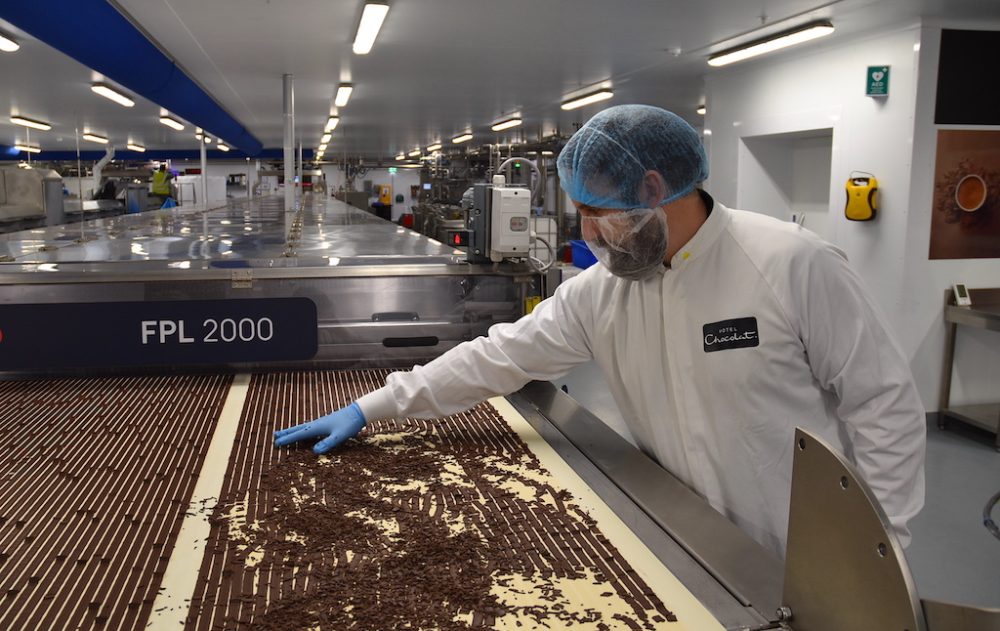
As Ollie states as we suit up with traditional manufacturing whites and fetching hair nets, the site is never a dull place to be around, with some 200 staff eagerly going about their respective roles.
This includes monitoring processes surrounding its latest products on the assembly line, which today includes its Fire and Ice truffles, combining Tasmanian Peppermint contrasted with Habanero chili infused into a 70 per cent dark chocolate – it’s certainly one that will linger long in the memory for packing quite some flavour punch.
Moreover, with Christmas now upon us, the business is ramping up key production across its portfolio, responding to demand not just from the UK – but also meeting requirements for its stores in Chicago, US.
Notably, the UK operations also operate a smaller secondary site at nearby St Neots, which is dedicated to packaging, preparing its ranges for wider distribution. With the company very much enjoying renewed buoyant fortunes under the stewardship of Mars, there’s a real vibrancy around its production headquarters.
“Within this business, no two days are really the same, we’ve got such a varied SKU range on different days, so we’re not making the same thing more than around once a month. There’s always something new to play with, to see and make, which is really good to see.
On a daily basis, it’s all about trying to excite our customers, and to make sure our products the best quality that they can be,” he enthuses of the operation, which continues to be dedicated to increasing and enhancing the ranges at its disposal.
Significantly, the company also crucially has planning permission to expand its Huntingdon site in response to growing international demand for its premium range of chocolate offerings.

As we explore its core production hall, its respective teams are all commendably focused on monitoring the many automated processing and packaging lines that are at the heart of its impressive operation.
One of the most significant factors revealing its progress has been in the relatively recent introduction of real-time monitoring screens displaying production stats for each day. These ensure each team is fully aware of how it sits against daily and weekly targets – with my visit showing charts encouragingly registering green for a positive position.
Ollie adds: “We have the four lines for our chocolate production, and they’re making between five and six million individual chocolates a week, it can go up to about ten. There’s about 400-500 different chocolates that we make off those lines, which is quite a lot.
“For the Velvetiser, we have 30 different flavours at the moment, which are currently being made off our line, but we also have a second one that has just been commissioned, which will enable us to probably product around 100 million sachets a year from those two. So, we really do produce a significant volume from a fairly compact site here in Huntingdon,” notes the production manager.
As he observes, the purpose-built additional hall, with its long conveyor system, is in the final phase of being fitted with an extra processing line, which shows just how significant the product is now to the company. Indeed, the market for premium hot chocolate appears to have gone through the roof in general, so creating an option for customers to make their own coffee shop grade options at home is proving a real vote winner all-round.
“I think one of the terms that the company uses is that ‘We’re here to Velvetise the world, so from a manufacturing perspective, we are here to make sure that all our customers are stocked up with all the variants of flake that they want. Our lines are big and impressive, and run very well.
“They make around half a million to 750,000 sachets a week, so that’s the role we play in it, and we have some fantastic flavours that have sheer variety,” noting the brand’s role is ensuring that consistent quality of its ranges to meet the demands of an ever-eager consumer base.
“I have been in the business just over six years now, so I started just at the very beginning of lockdown, and I’ve seen the business go through many different variants over that period, and it’s a really exciting time since being purchased by Mars. From my role’s perspective, we are now into global supply, so we have the fun and games of getting product to standard for Chicago where our new stores are, and really seeing what the future holds for the business.
“While the job does challenge you, it also empowers you to do all sorts of different things which is really good. And, at the end of the day, this is a chocolate factory, so we do try and have our fun. This is something that means a lot to the team in making it more than being a job,” reflects Ollie, who reveals that a large portion of its workforce is typically based around the Huntingdon area, and as such, there’s a proactive effort being made into giving something back to the surrounding area and its employees.
“It’s important to stay close to the community. We help out where we are able to with things like one of the local schools doing a production of Charlie and the Chocolate Factory, so we had students here who were making chocolate, and getting to know what an actual factory looks like. We also have our Christmas kids party – last year there were 165 well supervised children with their parents also trying to make chocolate,” adds Ollie.
“So, it is trying to make this more than a standard food factory, and I think that’s what makes us a bit different,” he concludes, as the company finalises its festive production plans that are helping elevate the business to its next chapter of success supplying the global industry.
Topics
chocolate Christmas confectionery innovation manufacturing new product development
PeopleOrganisationsRegions