Aeration art
Lately there has been a significant increase in the interest in and use of aerated chocolate. This is because an aerated chocolate product has enormous advantages, such as increased profit margin, creating authentic taste profiles and calorie cutting per portion.
Initially most chocolate was hard or would harden within a short period of time. Then, a few decades ago, commercial chocolate aeration started with the first patent of an aerated product – a breakthrough that introduced a quicker melting sensation to the taste palate. Even though scientific knowledge of bubble formation and stabilisation is still relatively poor, several methods to include bubbles into chocolate have since been developed.
Micro versus macro
Let’s first zoom in on the possible sizes of bubbles in chocolate. Micro bubbles can measure less than 20 micron are too small to be seen. A micro aerated chocolate will not differ in taste or mouth experience from a non-aerated one. The temperature stability remains the same as well. In fact, even the recipe usually can remain as is, keeping the product close to its original profile.
So what is the advantage of introducing micro bubbles at all? The first is an improved flavour release which augments the consumer’s level of taste experience. This will come as a surprise as there is no remarkable difference in the bar itself. Secondly, however invisible these bubbles are, they do in fact result in a ten percent decrease in the use of the most expensive ingredient, cocoa. Improving the profit margin accordingly.
In this article I will focus on creating the larger sized, visible bubbles because of their visual interest and eating quality.
How to get consistent bubbles
Identifying the keys to successful aeration leads us to the characteristics and amount of ingredients as well as the manufacturing process. The management of the chocolate in its molten state, the type of gas inserted, the temperature curve, the mixing speed and the layout of the aerator machine form an integral part in attaining the desired bubble.
The starting point is the basic ingredient. When processing chocolate its rheological properties are most important. Viscosity and yield factor will have an impact on bubble size. Chocolate is the only product with which we can create visible bubbles thanks to its specific characteristics. When we aerate other fat systems (creams, etc.) gas is introduced during the crystallisation phase and therefore encapsulated in the crystal structure. In fact this also results in bubbles but these will be invisible to the naked eye. Now for creating the desired large visible bubbles we dissolve gas during the liquid fat phase of the chocolate under higher pressure. This allows the gas to expand within the chocolate mass before solidifying.
Secondly, the choice of gas type to be inserted influences the final structure of the bubbles. Using nitrogen makes for very fine, invisible bubbles. To create the more open structure we’re after we need a soluble gas, carbon dioxide. We can play with this by mixing the different types of gasses and choosing the right mixture for our purpose.
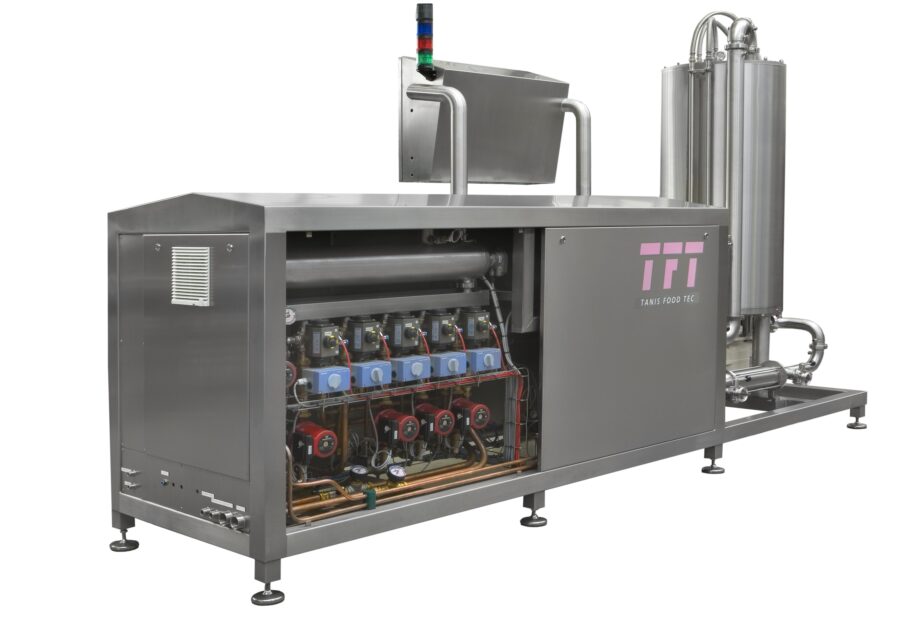
Next, it’s essential that the gas mixture has the right temperature constantly. Therefore the third determining success factor is a scraped surface heat exchanger, like TFT’s RotoTemp. Crystallising the chocolate fats is a matter of cooling surface and differential temperature. The larger the scraped surface area, the easier the temperature control. The small differential temperature between product and cooling medium allows for perfect control.
Now the gas is ready to be brought into the chocolate. This is done in the core part of the process line, the aerator. The layout of the aerator (or mixing head) consists of a rotating rotor moving within a stator. Both have large amounts of pins that work into one another. Their movement mixes the gas into the chocolate that is running through it. To improve foam stability it is recommended to use a combination of a mixing head with a premixing chamber. It will reduce the rotation speed and less mechanical heat is added to the product.
After mixing in the gas the aerated chocolate mass is deposited in moulds using a special depositor that keeps the product under pressure so the gas cannot escape and the bubbles will not collapse. Significant flavours such as mint or a colouring can now be added by injection. This method allows for the production of a neutral base and great flexibility in changeover to different flavours or colours to easily create a variety of consumer products.
| Bubble process in steps: | |
| 1 | Temper chocolate as usual |
| 2 | Inject gas while keeping product under pressure |
| 3 | Mix gas well into the product, without losing ‘your’ temper |
| 4 | Deposit in mould (shell mould preferably) with special pressure depositor |
| 5 | Let it expand atmospherically >> densities as low as 0.4kg/l and a bubble size of 2mm are achievable |
| 6 | If bigger bubbles are desired, then vacuumising after depositing is necessary |
Summarising we can conclude that putting the bubble into chocolate comes down to a single word: control. Viscosity, density, capacity, temperatures and crystal structure all need to be exactly right and continuously so.
Bubble benefits
Specialised control programmes and equipment make the aeration process itself an instrument to completely control the amount of ingredients used. It is imperative to cut back the use of the most expensive ingredient to make your manufacturing financially viable, while simultaneously augmenting the durability of your company. And, obviously, where there is air in the product, there is no chocolate.
Aerated chocolate products can tap into the ‘light’ trend amongst consumers because per portion the calories are reduced albeit not by weight. Aeration allows chocolate products to have a low weight in relation to volume.
Marketing by taste and texture
A former researcher for Nestlé, Stephen Beckett, expressed his experience on internet, “If you aerate chocolate, it tends to be creamier. Its density is so low it melts very easily, and gives you a different taste.” In fact it is the very melting in the oral cavity that causes the flavours to release and makes eating chocolate such an intense delight for the senses. The fun visual effect of the large bubbles in the final product is coupled with a unique texture. Marketing experts state that consumers today have far greater expectations than ever before. Food experience, tastes and textures are what they crave. Their loyalty to a brand is boasted by product superiority. Manufacturers are challenged to deliver according their need. Transforming the traditional chocolate ingredient and giving it an authentic profile raises the bar quite literally.
Expansion of product portfolio
As the big bubble aeration process alters the taste, texture and melting sensation of chocolate it becomes a new medium to explore. And the possible introduction of flavours and colours to the chocolate foam in the final depositing stage of the aeration process creates endless interesting product possibilities.
What product would you make?
Think out of the box. For example, create a combination of a ‘crumble’ biscuit shell with an aerated chocolate, or layer the bubble chocolate between wafer sheets. Create…
– Moulded chocolate
– Fillings for moulded chocolates
– Fillings for co-extruded products
– Deposited on biscuits or wafers
By Peter Tanis, CCO of Tanis Food Tec