Vegan confectionery enters new innovation era

From flexitarian demand to clean label expectations, vegan confectionery is advancing rapidly, with innovation in ingredients, texture and technology reshaping product development across this fast-growing sector. Daisy Phillipson reports
Did you know that the vegan movement began more than 80
years ago? Though the concept of avoiding animal products dates
back centuries, Donald Watson and Dorothy Morgan coined the term and founded The Vegan Society in the UK back in 1944 to advocate for the diet and lifestyle choice, separate from vegetarianism.
The movement has come a long way since then and has undergone a significant evolution in recent years. More and more consumers are adopting flexitarian diets, an eating style that reduces meat and animal product consumption without eliminating them entirely.
This is very much evident within the confectionery industry. In fact, research presented by Sunshine Snacks Ltd, which offers a range of plant-based and halal sweets, found that just 30 per cent of vegan sweet purchases are made by those dedicated to the diet during Veganuary.
The rest, the company states, are flexitarians, vegetarians and omnivores who are driven by health concerns, environmental awareness, dietary restrictions or simple curiosity.
The trend is also growing worldwide, with market insights firm 360iResearch noting that the global vegan confectionery sector grew from $2.45 billion in 2025 rising to $2.75 billion in 2026.
This upwards trajectory is set to continue at a CAGR of 13.62 per cent and a market value reaching some $6 billion by 2032. Key drivers include consumer demand for plant-based options that match traditional candy in taste and texture, but it’s also worth highlighting the fact that as the segment
evolves, there’s a rising focus on ingredient traceability, clean labels and ethical sourcing.
In 2026, consumers expect more from their plant-based products, seeking natural and sustainable claims. This was reflected in Innova Market Insights’ top ten food trends for 2026, one of which was ‘authentic plant-based’. Its
research found that nearly two thirds of consumers surveyed globally by Innova said that plant-based products should be able to stand alone, rather than being substitutes for other foods.
Elsewhere, Talia Profet, European chef lead at ingredients firm ofi, commented on this shift in savoury dishes. “I’ve noticed the plant-based trend really shifting in a fun direction lately,” she said. “It’s less about mimicking meat and more about celebrating real ingredients – think vibrant veggies, fresh fruits and bold, unexpected flavour combos.
This shift is also evident within the confectionery sector, but delivering on these expectations at scale remains a challenge.
Last year, Nestlé confirmed it would discontinue its vegan KitKat V after four
years on the market. Despite receiving high praise for the taste, the product required its own separate manufacturing facilities at its British base, which ramped up the costs.
While the decision was influenced by a range of commercial factors, it also highlights the broader pressures facing manufacturers as they work to balance cost, formulation and consumer expectations. However, this is not to say there aren’t significant opportunities within the category.
As industry players continue to invest in innovation and collaboration, new routes to market and product development are helping brands unlock growth in the vegan confectionery space.
As explained by Cornelia Schaffrath, product line senior director of edible oils Europe, Cargill, “Demand in 2026 is being shaped by a dual imperative: improve nutritional profiles while preserving indulgence.”
Talking textures
For manufacturers, the challenge now is not whether to enter the category, but how to deliver products that meet these increasingly complex expectations. One of the biggest factors to consider in vegan confectionery is texture, which can be impacted in products like gummies and marshmallows when removing the animal-based gelatin.
As observed by Stefan Wessel, customer application specialist at ingredients business Avebe, substituting such ingredients for the costly traditional gelling agents isn’t always very simple.
“Achieving the right balance of firmness and chewiness in plant-based
gummies, jellies and pastilles can be challenging,” he says.
Gelatin provides a unique elastic texture, which can be very difficult to replicate with plant-based ingredients. At the same time, there are costs to factor in. “Cost issues, changing consumer preferences, misconceptions about alternative solutions,”
Wessel adds: “The confectionery industry is facing several challenges right now, and many producers are struggling to adapt without compromising product quality.”
One such solution to overcome these issues is PerfectaGel, Avebe’s key brand for confectionery potato starches. Wessel notes how these starches consistently achieve the firmness, chewiness and elasticity consumers
expect in premium confectionery while also being a cheaper alternative to gelatin and pectin.
They are said to offer fast-setting times and low viscosity, allowing producers to reduce energy costs or increase factory output by up to 50 per cent. Additionally, PerfectaGel helps manufacturers to cater to growing demand for sustainable and ethically sourced ingredients.
“Both individual consumers and businesses are starting to scrutinise supply
chains more closely, and are favouring confectionery ingredients that have a lower environmental impact,” Wessel continues.
“PerfectaGel, as a plant-based, starch-derived solution, offers a more sustainable and ethical supply chain. This is because potatoes are a widely available, renewable crop, with a relatively low environmental impact.”
For a plant-based alternative to traditional gelling agents, natural tree exudates firm Alland & Robert offers Syndeo Gelling, which won the Innovation in Ingredient Award at our 2025 World Confectionery Conference in Brussels.
Combining gum acacia and plant-based, natural hydrocolloids, the texturing solution provides natural stabilising, gelling, thickening, binding and texturing properties in vegan products.
Advances in ingredient solutions are translated into new product development,
with a range of innovative new plant-based products hitting the shelves over the past year.
American former pro quarterback Tom Brady tapped into this growing market by announcing the launch of his vegan GOAT Gummies, developed in collaboration with Instant Commerce brand Gopuff.
These gummies contain no artificial sweeteners, dyes or flavours, and are made of real fruit, with Brady and the Gopuff team perfecting the flavours, textures and clean label requirements. Each pack of GOAT Gummies are
available exclusively for delivery on Gopuff, with three available varieties: Sweet Rush, Sour Burst and Tropic Fusion. UK-based confectionery brand Candy
Kittens has also expanded its vegan portfolio with the launch of its new Lucky Cherry product, which combines traditional gummy formats with softer, foam domes to deliver a more varied texture profile.
The product is made without gelatin, using plant-based ingredients such as starch and proteins to achieve the desired chew. It also incorporates real fruit juice and natural flavourings. Their colour is derived from fruit and vegetable concentrates, including black carrot and sweet potato, aligning with growing consumer demand for clean label formulations and naturally derived ingredients within the vegan confectionery segment.
Expansion of services
Clearly, businesses are having to work notably hard to expand and broaden their portfolio given a number of background supply chain challenges.
But one enterprising British business, Plamil Foods, has taken proactive steps to enhance its vegan and wider production offerings in forging fresh opportunities for companies seeking own-brand product ranges.
In addition to delivering its own lines, the Folkestone firm has now moved to offer its customers an extended range of specially produced own-brand offerings supplied with flexible and reliable service.
As Plamil noted, it now offers chocolate packed into a wide range of pouch formats, available as fully printed or label finished options.
This flexibility allows businesses to build their own retail or foodservice proposition with ease. Current pouch sizes range from 250g to 2kg, making them suitable for consumer retail, professional kitchens, bakeries and manufacturers alike.
Plamil’s Adrian Ling believes its expanded operations would prove a strong
addition to its operations, supported by an experience team, which has previously claimed honours at our World Confectionery Conference for its capabilities.
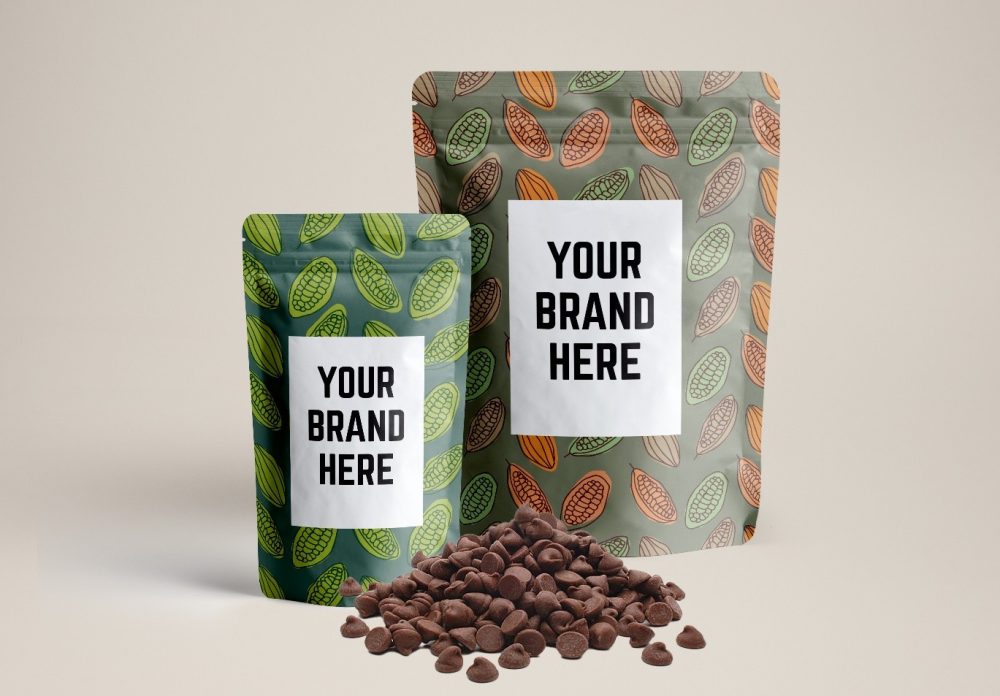
pic: Plamil has extended its offerings into delivering own-brand pouches for its customers. Pic: Plamil
As we recently reported, the experienced business leader, who has continued to extend the range of offerings over the years, including its So Free vegan chocolate, will be returning to play his part among speakers at our conference in London this September.
Adrian Ling enthuses: “We are proud to continue supporting companies launching new products, expanding existing ranges, or simply seeking more flexible packing options.
“We are uniquely combining flexible packing options with a choice of cocoa
certifications, drop sizes and other shapes, enabling us to support every type of business. From small start-ups to high volume packing, we can provide a service that fits.”
Meanwhile, back in the US, better-for-you candy brand Joyride dropped a number of new, innovative products to expand its offering, containing at least 50 per cent less sugar than the leading brands, no artificial sweeteners or colours, and a good source of prebiotic fibre. That includes the vegan-
friendly Joyride Fruit Chews, which contain four bold flavours in each bag including trawberry, Lemon, Cherry Berry and its Fun Drink.
Naturally bright
Beyond texture and flavour, colour is another key consideration in vegan confectionery, particularly as the shift towards plant-based products is closely aligned with clean label ingredients. Natural food colouring companies such as GNT are able to cater to demand while achieving the bright, bold hues consumers expect from confectionery products.
Rutger de Kort, sustainability manager, GNT Group, explains: “There’s very strong demand for colours made from fruits, vegetables and plants across the
confectionery and sweet bakery sectors.
“They’re already the industry standard in Europe, and they’re gaining rapid momentum in many other parts of the world too, especially with the US working to phase out petroleum-based dyes.”
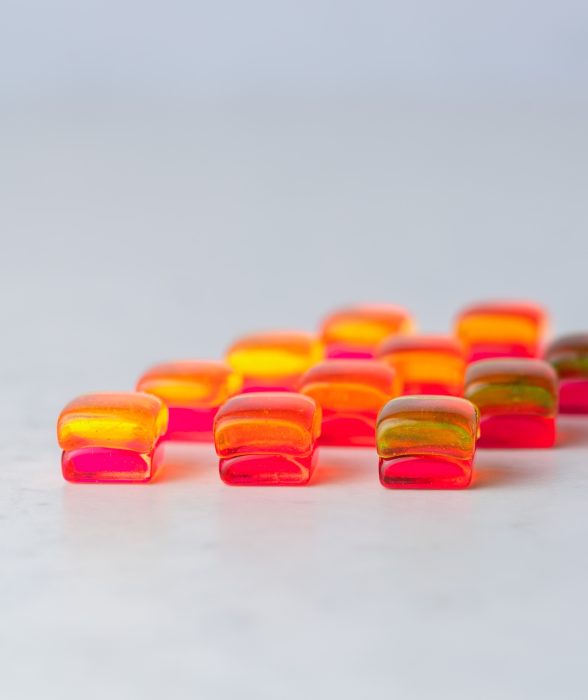
While natural colours vary in regard to production methods and labelling expectations, most are created by selectively extracting the pigments.
“Our Exberry carotenes, for example, aremade from a type of algae using essential oils to extract the natural yellow pigments. They can be labelled
‘Colour: Algal carotenes’ or as ‘Colour: E160 a’ if preferred,” adds de Kort.“We also offer a complete rainbow of concentrates that are processed using
physical methods. These colours allow for clean and clear label declarations such as ‘carrot and blackcurrant concentrate.’ That can be a real benefit, especially in premium products or where the natural ingredients are
an important selling point.”
A producer tapping into several of these dynamics at once is Sockerbit, which recently expanded its presence in the US, launching in nearly 1,600 Target stores nationwide as well as online.
Founded in 2010, the Swedish candy brand has built its identity around the
Swedish tradition of lördagsgodis (“Saturday candy”), a weekly ritual of planned indulgence that aligns with consumer demand for intentional moments of reward.
Its range comprises colourful gummies designed for both children and adults, while addressing rising expectations around natural alternatives, with products made using non-GMO ingredients that are also free from high fructose corn syrup, trans fats and artificial dyes. A number of its products
are also vegan-friendly.
That includes the Sour & Fruity Heart Gummies, which are heading to Target.
Instead of gelatin, their gummy texture is achieved using potato and pea starches, while the bright and bold colours and flavours are thanks to natural flavourings, concentrates such as spirulina, safflower, black carrot juice and grape, and colours from curcumin and paprika extract.
Elsewhere, plant-based confectionery company Sweet Lounge added fizzy Tropical Pineapple sweets to its range. Amid the rising interest in better-for-you plant-based products, many brands are blending sugar confectionery with real, whole fruit, with a wealth of innovative date products hitting the shelves. One firm operating in this fast-growing segment is Smood Sweets, which offers a variety of candy-covered dates.
Among its latest additions are StrawberryBubble Gum flavoured dates, which are plant-based, gluten-free, and contain no added sugar, artificial flavours, or artificial colours. As for how they achieve their bright pink hue, the Strawberry Bubble Gum dates contain vegetable juice.
Ice cream innovation
Natural colours also play a key role in ice cream innovation, including plant-based varieties. In response, natural food colour business Oterra has developed a series of ice cream ‘lookbooks’ based on key consumer and market trends, designed to guide manufacturers on how to apply naturally derived colours in product development.
“To bring these concepts to life, we prompted Artificial Intelligence tools
informed by this research and our concepts to generate realistic images to inspire our customers,” explains José Luis Soto, LATAM, marketing officer at Oterra.
“These photorealistic images have been gathered together in Lookbooks that each represent one of the four concepts identified.” The first lookbook focuses on unique solutions with unconventional shapes, as well as striking colour and
flavour pairings. Additional trends set to be added include sensory ice cream, snackable products, and premium formulations. Cargill has also been innovating in this area, developing a range of ice cream prototypes, which form part of its extended range of confectionery offerings.
Among the prototypes is a re-imagining of the breakfast ice cream bar, combining a crunchy granola-chocolate base, refreshing oat milk sorbet, and tangy mango curd, coated in dark cocoa and granola.
Opportunities in ice cream are also supported with its new indulgence redefined portfolio, represented by a vegan ice cream with cocoa alternative to confectionery coating. Anne Mertens-Hoyng, category director for chocolate confectionery and ice cream at Cargill, comments: “Today’s consumers want distinct flavours, nostalgic twists and unforgettable textures.
“Cargill’s portfolio of sauces, fillings and coatings can help bring these indulgent, multi-sensory experiences to life, meeting evolving tastes and expectations. With our skilled ice cream specialists and state-of-the-
art facilities across Europe, we can tailor solutions to meet customer requirements.”
Little Moons, the mochi Ice cream brand that has taken the world by storm – taps into multiple trends at once, including the demand for innovative texture and flavour combinations, bright and bold colours and better-for-you options. It’s now addressing one more – convenience, with the new on-the-go two packs of mochi ice cream.
The first flavour in this range is the Very Berry sorbet, which is vegan, gluten-free and contains lemon and lime juice. It achieves bright pink hues through natural colours, including annatto norbixin and curcumin.
The future of vegan chocolate
Similar technical challenges must be overcome when creating plant-based
chocolate. Achieving the desired mouthfeel and texture is of utmost importance, while new products must cater to rising trends
such as premium offerings or functional components.
There’s also the issue of volatile ingredients costs to consider,
highlighted by emulsifier firm, Palsgaard. The company notes that when removing dairy components from milk chocolate to create a plant-based alternative, there are several challenges that can lead to the
over-use of cocoa butter and subsequently higher production costs. However, the firm can overcome this issue in plant-based recipes with its solutions.

For instance, by replacing 0.4 per cent of lecithin with 0.4 per cent of Palsgaard AMP 4455, it is considered possible to avoid overusing cocoa butter.
As a phospholipid, AMP was created specifically for chocolate with the aim of
replacing lecithin, while also reducing viscosity, meaning that the additional
two-three per cent of cocoa butter is no longer required. AMP 4455 is sunflower based, while AMP 4458 is rapeseed based.
Orlando Ramírez Gómez, senior application specialist, confectionery,
comments: “At Palsgaard we can help chocolate and plant-based chocolate
manufacturers make that switch from lecithin to Palsgaard AMP 4455. It might
seem like a headache to change an existing recipe, but we can help make the transition seamless and straightforward.”
Furthermore, Colombia’s ethically- focused Luker Chocolate highlights the
opportunities present within the growing vegan chocolate segment, with health remaining a major driver.
The firm highlights Innova Market Research’s data that 42 per cent of global consumers associate plant-based products with being healthier, while 35 per cent connect them with naturalness.
It goes on to state that brands are offering additional health benefits, such as natural sweeteners and superfoods. Similarly, protein-fortified chocolate is rising in popularity, which Luker has tapped into with a 44 per cent chocolate formulated with pea protein, containing five grams of protein in a 25-gram serving.
The firm also launched Dairy-Free Oat M!lk Chocolate, putting a plant-based twist on its current offerings. Last year, vegan chocolate brand NOMO unveiled a trio of innovative new flavours for the UK market: Salted Popcorn,
Birthday Cake, and an updated version of its Cookie Dough bar. Its latest offerings continue the company’s mission to deliver quality, inclusive treats.
As vegan confectionery continues to evolve, innovation is no longer limited to
ingredients alone. Manufacturers are increasingly turning to digital tools and
advanced technologies to speed up development and meet rapidly shifting
consumer expectations.
Leading the charge is Barry Callebaut, which has entered into an agreement with NotCo AI – said to be the first foundational AI platform for the consumer goods industry – to explore implementing artificial intelligence in chocolate recipe development.
By exploring new avenues in taste, texture and sustainability, they aim to accelerate innovation and deliver faster, more tailored customer experiences.Barry Callebaut issued a statemeont on its project. It notes: “By combining our deep chocolate expertise and global reach with NotCo’s advanced AI capabilities, we’re aiming to unlock speed for breakthrough
recipe solutions, from health-forward formulations to functional ingredients and Nutri-Score options.
“With the pace of change across the industry and the cocoa market, our
customers’ needs are evolving rapidly. This collaboration enables us to test how AI can enhance process efficiency and scale our innovation efforts to meet future demands and allows us to accelerate our ways of working to deliver the best possible customer experience.”