Pouch systems making an impact on packaging markets
Extending product endurance and adding creativity to product ranges are just two of the reasons pouch systems are continuing to make their mark in the confectionery and wider food markets, as manufacturer Volpak explains of its equipment series.
From snacks and household products to baby food and beyond, pouches can be adapted for pretty much any product and industry.
Various filling and packing technologies are employed in the production process of the pouches to guarantee full protection and freshness of the packaged product every time.
They also ensure long-lasting freshness within the flexible packaging, while also extending the shelf life. Since pouches can easily include resealable options such as zip-locks and many others, goods may last longer even after they are opened by the customer.
This adds great value for the modern consumer who is always on the move, by offering multiple solutions for carrying and storing liquid, powders, solids, and so on. There are also plenty of exterior aesthetic options to play around with. With pouching technology, you can stretch your imagination to create all sorts of unique shapes, sizes, materials and components, giving you complete freedom over the look and feel of the pouch.
From economical to ecological impact
But when we talk about flexibility, it’s also important to consider the wider impact. From the production to distribution processes, flexible pouches are by far the most cost-effective packaging solution, as well as being the more ecological one compared to cans, jars, bottles or boxes. For one, the manufacturing process of flexible pouches is much simpler.
It takes far less material to produce pouches compared to rigid packaging solutions, and thus has a much lower production cost. With the highest product-to-package ratio of any other packaging solution, pouches are more compact in space and lighter in weight than cans or jars. This makes them more efficient to transport, thus reducing both transportation costs and CO2 emissions. Even in cases where the packaging is not recycled after use, leftover pouch material still creates less landfill debris, since there was less material to begin with. Plus, efficient manufacturing technology like Volpak machines enables less heat to be used in the production process, meaning the amount of energy is reduced from the get-go.
Investing in technology to enhance sustainability
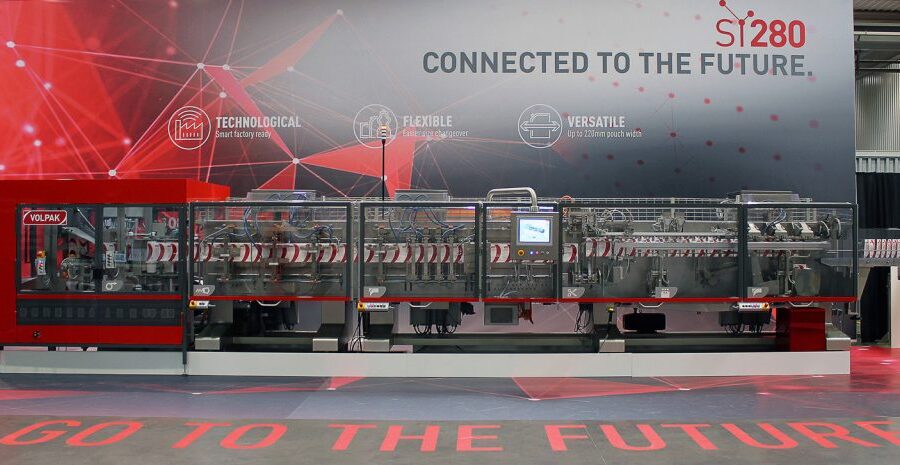
While the packaging industry continues to push for the use of recyclable materials, thereby bringing significant challenges for manufacturers on equipment performance level, Volpak has already developed the technology to operate with recyclable materials. Stability in the forming process, control of film stretching, precise settings and accurate control of sealing parameters (namely time, pressure and temperature) are key elements to producing good quality and leak-proof pouches, especially if made with down-gauge packaging films. Machines such as the SI 280 or the brand new SC+ are equipped with cutting-edge solutions for management of different packaging materials qualities.
Moreover, all latest Volpak machines address the needs and requirements of Industry 4.0 and digitalisation, hence come with a set of “smart” advanced devices such as an asset performance evaluation system, central data storage, web-based self-diagnosis system and plug & play interconnectivity. These features contribute to achieve a perfect result in forming and filling pouches, but help as well in sustaining the environment, reducing waste both in terms of energy and materials.