UK grown cocoa delivered for Reading University centenary chocolate bar

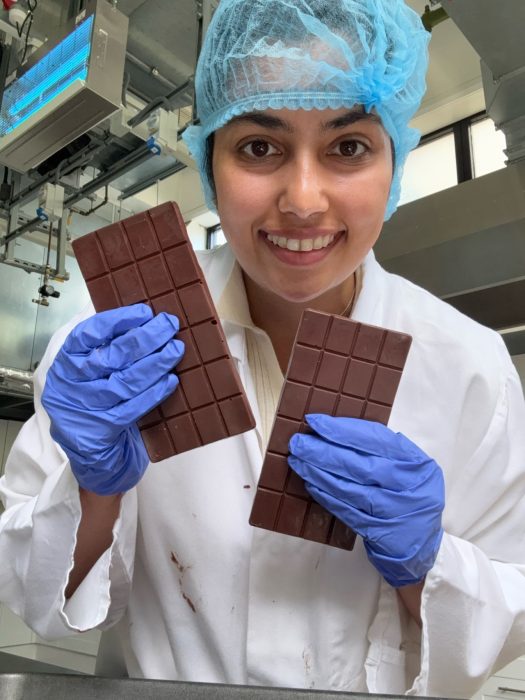
Maha Khan with Reading University's centenary chocolate bar. Pic: Reading University
Celebrations for Reading University’s 100th anniversary have included a rare special feature – a chocolate bar developed with cocoa grown in its own labs rather than from typical equatorial sources, writes Neill Barston.
As our title has covered extensively, two thirds of cocoa crop supplies have traditionally come from West Africa, with Ghana and Ivory Coast being the largest singe suppliers, due to its key environmental conditions.
While cocoa continues to be grown in smaller quantities in warmer locations around the world, including as far and wide as Brazil and Indonesia, colder climates have not been suitable for its growth,
But as Reading University explained, its International Cocoa Quarantine Centre, a unique collection of more than 300 types of cocoa plant, which handles 97% of the world’s international movement of cocoa plants, has been drawn upon for a commemorative bar.
The facility has served a notable purpose in helping prevent the spread of pests and diseases between growing regions, which as Confectionery Production has reported, have been particularly notable in recent years, with Swollen Shoot virus and witches broom being among the most destructive issues around the world within the sector.
As the university noted, while this is a rare instance of British cocoa, it is not in fact the first effort, with the first completely British ingredient chocolate being made in 1932, when Rowntrees gifted a six-year-old Princess Elizabeth (later Queen Elizabeth II) a bar of UK-grown chocolate, making her the first person in history to eat one.
In addition, there have been more recent instances including the Eden Project in Cornwall by local Cornish craft chocolate maker Chocolarder, which also sourced Reading University cocoa.
Against a backdrop of major challenges with traditional cocoa sourcing locations, there have been a handful of lab-grown cocoa-alternative companies that have sprung up in the last few years, including California Cultured in the US, synthesising beans. In addition there are several notable firms exploring chocolate like experiences, including Planet A Foods – which is set to speak at our World Confectionery Conference as part of our Q&A on sustainability on 10th September, Registration for the event remains open directly via our dedicated website through this link.
Moreover, as the university noted, with the UK’s chocolate valued at around £10.4 billion, it is entirely reliant on cocoa crops largely sourced from West Africa – which remains threatened by crisis conditions of adverse weather, ageing farmers, and disease-hit crops. Indeed, recent industry estimates asserting that up to one third of cocoa crops in Ivory Coast and neighbouring Ghana could be affected by swollen shoot virus – which is extremely hard to detect, and can render farms out of action for up to five years.
As for the British effort, it was created by Maha Khan, a University of Reading food security master’s student. Her work on the project included harvesting, fermented, and processed the locally-grown cocoa, before making the finished product in its Department of Food and Nutritional Sciences.
She said: “It has been amazing to follow the entire chocolate-making process, from pod to bean to bar, without leaving Reading.
“This British bar of chocolate highlights the precarious nature of our food supplies. Cocoa plants are very sensitive to changes in temperature and rainfall, and climate change is already causing problems in countries that produce most of the world’s cocoa. Protecting different varieties is vital if farmers need hardier plants that can cope with a changing climate.
“I hope this shows people just how much work goes into the chocolate we enjoy, and how important it is to protect cocoa farmers and communities around the world.”
Commenting further on the project, Professor Carol Wagstaff, director of AgriFood Futures at the University of Reading, noted that the UK chocolate industry rests on a supply chain that starts thousands of miles away in the tropics of Arica, South America and Asia.
She said: “A resilient global market is crucial to the many smallholder farmers who underpin the industry and find themselves farming in some of the regions most exposed to risks from climate change, as well as to chocolate makers and chocolate lovers in the UK.
“While growing and buying local produce often makes sense for your health, and helps the economy and environment, it is not a universal rule. International trade in food can be a good thing, providing economic stability for communities whilst using natural energy resources for production, and we need to invest in research to keep threats at bay.”