Taking the biscuit to the next level

With interpack on the horizon, machinery for the biscuit market will be prominent at this year’s key event. Neill Barston quizzes major firms Syntegon and Schubert on some of this year’s most topical industry developments
While there’s no escaping the prominent supply chain challenges facing the combined confectionery, snacks and wider food production sector, biscuit manufacturing has maintained its position as a highly-prized market segment.
Indeed, the likes of Mondelez International, with its ever-evolving Oreo brand in the US and Ferrero-linked Fox’s Burton’s, through to British orientated businesses such as McVities, there’s been plenty of innovation on display in recent years as products evolve.
As anyone who has tracked the sector in recent times will have seen, it has not been without its challenges, most notably with regards to ingredients prices, particularly with cocoa.
This has prompted some significant manufacturers, such as pladis-owned McVities, to alter recipes of classic brands such as Club and Penguin, to the point of them no longer being able to be classified as chocolate ranges. Only time will tell as to whether consumers are prepared to stomach such changes, but it clearly generated plenty of media headlines.
In spite of such tests, the segment still appears to be thriving, with latest global figures from Data Bridge indicating the international market rising from $130 billion in value for 2024, to a tally of more than $200bn over the next five years.
Clearly, a major component in this growth comes in having the right equipment and lines in place to handle expanding demand, with manufacturers remaining razor-focused on increasing productivity, as well as delivering sustainability-linked production efficiencies.
Major players
As Daniel Bossel, global product manager for the German-headquartered Syntegon group explained, there is indeed in his view a good deal of resilience within the sector.
The Swiss-based specialist noted that the market has thrived in terms of positioning itself as an affordable indulgence, at a time when many other general groceries have been rising significantly, against a backdrop of a cost of living crisis in recent years.



He noted that while there appeared an upward trend in the market’s performance, there are also structural shifts at play within the segment that are redefining production requirements.
“Consumer expectations are evolving rapidly. Health-conscious formulations – reduced sugar, added protein or fibre, gluten-free or lactose-free – are no longer niche offerings but part of the mainstream portfolio.
“Simultaneously, demand for convenience formats such as single-serve packs, resealable solutions and on-the-go products continues to grow. For manufacturers, this means greater stock keeping unit diversity and more frequent changeovers,” explained Daniel.
As he noted, one of the most significant developments in the segment is the growing complexity of product handling. Consequently, alternative recipes, especially gluten-free or vegan variants, are often more fragile and require particularly gentle processing.
Moreover, he explained that the business is observing increasing demand for flexible system designs that combine precise handling with fast format changes, allowing producers to maintain efficiency despite expanding portfolios.
He added: “Cost pressure remains a defining factor. Rising raw material and energy prices are intensifying the focus on yield optimisation and waste reduction. Advanced robotic handling solutions and precise motion technologies are helping to reduce breakage and improve overall equipment effectiveness – a core lever for profitability in high-volume biscuit production.
“Sustainability is another major driver of innovation. Regulatory frameworks such as the EU Packaging and Packaging Waste Regulation (PPWR) are accelerating the transition towards recyclable mono-materials and paper- based packaging. These materials behave differently in processing and sealing, requiring adapted packaging technologies and close collaboration between material suppliers, manufacturers and system providers.”
Notably, he added that labour shortages are pushing automation and digitalisation further up the strategic agenda. Integrated production systems with real-time data monitoring and predictive maintenance capabilities are becoming increasingly important to ensure stable output and reduce unplanned downtime.
Daniel concluded: “From our perspective, success in this environment depends on holistic system thinking. Cookie and biscuit manufacturers are looking beyond individual machines towards integrated solutions that combine product handling, packaging, automation and digital services. Those who embrace flexibility, efficiency and sustainability in an integrated manner will be best positioned to navigate the ongoing transformation of the biscuit market.”
Flowpack significance
In terms of core factors shaping the biscuit market, as Schubert explains, the delivery of effective flow wrapping remains at the core of the segment.
As the business noted, flowpacks, which bond film layers together, perform a vital role in protecting delicate products like biscuits, which require utmost care during packing.
Moreover, as no two biscuit ranges being the same, manufacturers are faced with flow-wrapping challenges to meet bespoke needs of individual series.
The overall biscuit and film structure mustn’t be affected by speeds and sealing times, as consumers want to enjoy the products in their original state.
As Schubert added, the choice of sealing method is largely determined by the packaging material and product in question. Composite films made from different types of plastic, such as polyethylene (PE), polypropylene (PP) and polyamide (PA), have different melting points and are ideal for heat sealing, as long as the products are too.
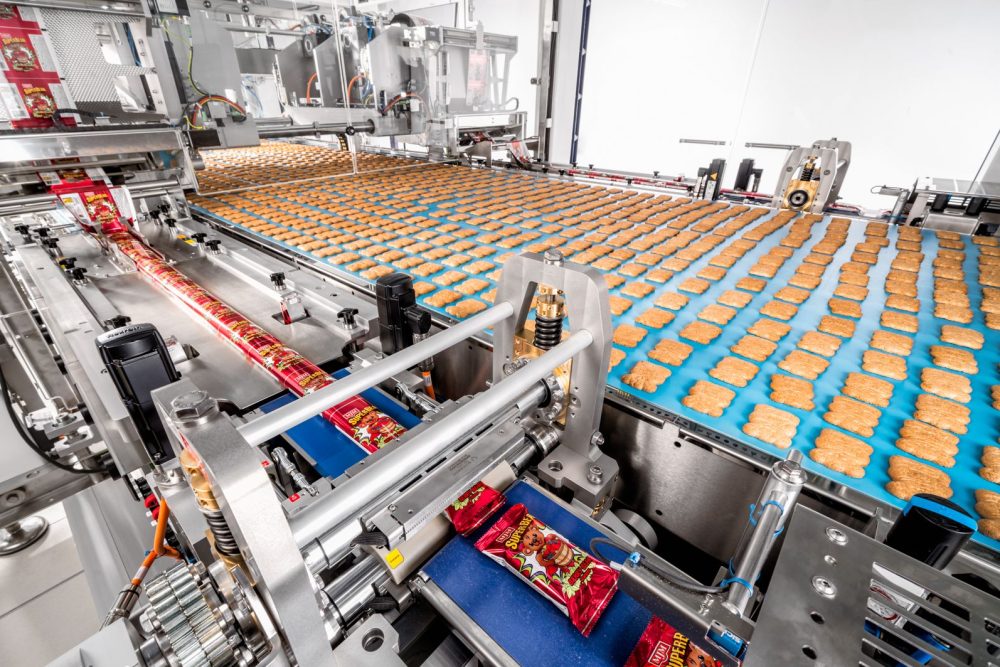
For less heat-sensitive products, heat sealing with composite films is a viable option. During the process, two layers of film pass between heated jaws. The sealing layers soften or melt, allowing molecular chains to interlock. Pressure ensures contact, and after a short holding time the film cools and solidifies into a strong, dense seal.
More sensitive materials, such as mono-materials and paper-based films, require a gentler sealing method, such as ultrasonic sealing. The latter is ideal for temperature-sensitive goods, such as chocolate or fragile products, as the lower sealing temperatures prevent melting or other damage to the products. However, the insulating properties of the aforementioned films mean heat takes longer to penetrate through the material, which can slow the sealing process.
As the business observed, ultrasonic sealing addresses many of these issues. High frequency vibrations generate friction, producing heat directly at the contact point between the films. This process softens and bonds the material under pressure without the need to heat large areas. This makes it suitable for producing recyclable flow-wrap packaging from monofilms or paper-based films, as well as for packaging delicate biscuits.
Moreover, flow-wrapping lines, when used in combination with versatile pick-and-place robots, ensure that products are handled gently from the outset.
Solutions such as Schubert’s Flowmodul integrate pick-and-place robots that, for example, load the chain of their associated flow-wrapping unit. These robots offer high performance and gentle handling on a reduced footprint. The sealing units in the Flowpacker can be adapted to accommodate various sealing methods, including ultrasonic, heat and cold sealing.
Furthermore, the company has played a key role in transferring ultrasonic sealing technology from thermoforming applications to horizontal flow-wrapping machines.
For example, working with Herrmann Ultraschall, the company introduced its Flowmodul flow-wrapper in 2016 and later developed the Box Motion ultrasonic cross-sealing unit.
Notably, for interpack 2026, Schubert confirmed that it will be in the mix of a host of businesses serving the confectionery sector, and is set to unveil its latest Flowpacker in the form of its latest TLM generation. This will reportedly offer a stiffer frame and optimised robot tools for even higher performance, and offer just one of many highlights at the biggest show in the sector taking place very shortly this May.