
Delivering Uncommonly good sustainable artisan chocolate

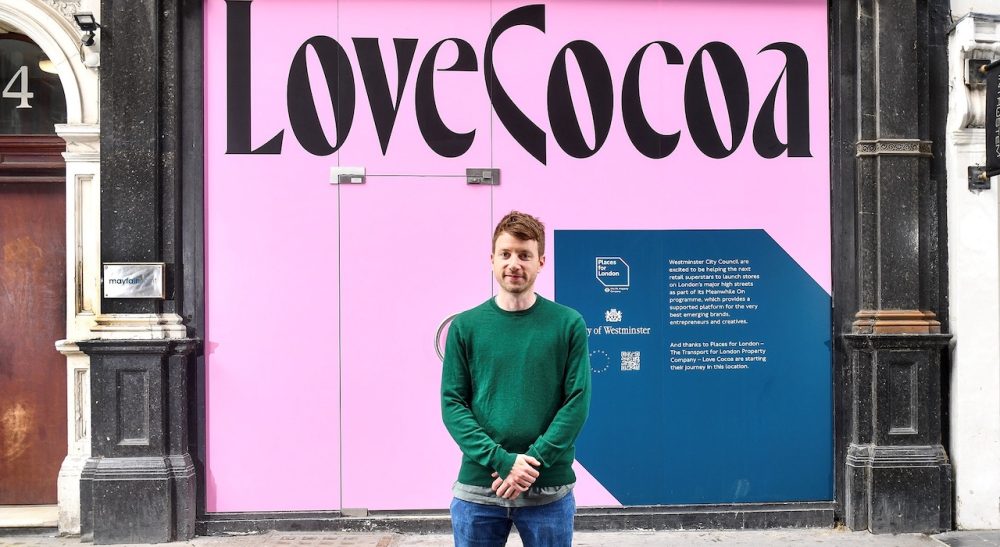
Calum Haggerty, of Made Uncommon, has recently acquired Love Cocoa confectionery business. Pics: Made Uncommon
With the cocoa sector hit with high pricing, environmental concerns and competition from alternative ingredients, the industry is facing volatile conditions. Consequently, sustainable sourcing is as crucial as ever for the sector, as Calum Haggerty, founder of Made Uncommon discusses with editor Neill Barston.
Making the decision to switch firefighter into becoming a business owner in the
confectionery sector is perhaps an unlikely journey into the industry.
But as Calum Haggerty, founder of Made Uncommon enthuses to our title, it’s a move that may well have seen a huge amount of work, yet it is continuing to prove particularly rewarding.
To his credit, there’s been more than a few plaudits in his time, with the mission-driven business based around sustainable sourcing across its brands has gained coverage in everything from the Vogue magazine and Vanity Fayre through to the Financial Times.
His is an inspiring tale of determination amid comparative adversity facing small businesses in the UK, yet it’s often surprising just how far an ambitious and enterprising spirit can carry someone.
As Calum acknowledges, while the challenges remain many within the sector,
from the recent steep rises in input costs and stagnant underlying British economy, through to evolving its creative direction, he is proud of what is proving a growing team of dedicated staff around him that have helped propel the business forward.
“Like most things in my life, I have fallen into them almost by accident, and I was intending to get into the fire service. I am originally from Inverness and moved to Edinburgh for university, where I studied business. I didn’t know what I wanted to do afterwards, but I just knew I didn’t want to work in an office, which ironically is what I do now,” he explains of those early days.
He continues: “So, as I finished my course I saw an ad for the fire service, and within six weeks I was in the Scottish fire service, I was in there for eight years and fell into the chocolate industry, and we still have the first business, Cocoa Chocolate in Edinburgh, and the guy who had run it had two stores there but was looking to move back to Australia – so I just threw myself into the deep end with it,” he reflects upon that leap of faith in 2013 that was to determine his path in confectionery.
Notably, he had fostered a passion for art and design, which he poured into working on a revamp for his newly-inherited venture’s overall branding and repositioned from retail to wholesale focus, as well as ensuring the delivery of its in-house manufacturing operations that have remained critical to the group.
“I would say being very naïve was actually a strength, as if I’d have known what I was getting into, I would probably never have started. But I’d always interested in business, and I was one of those kids that would be selling sweets out of their lockers at school. I had that draw towards working for myself.
“So learning about the chocolate industry was a fascinating thing indeed, as at tha point, I only knew as much as your regular consumer,” he admits of his company debut, which he recalls with much fondness.
Company development
Clearly, as he reveals, the evolution of the group has not always been entirely plain sailing, with the business having to navigate the choppy waters of Brexit, and conditions in the UK over the past decade that have made exporting to Europe somewhat challenging.
But with strong ethical framework and sense of purpose behind its fledgeling core of three brands, the business increasingly entrenched itself within the wider industry.
Moreover, while some companies may seemingly pay lip service to the notion of
being sustainable in their outlook, as Made Uncommon’s director notes, it really has been integral to all of its brands. Confectionery Production has spent
considerable time reporting on major developments within cocoa supply chains, including West Africa, which still makes up two-thirds of commercial chains for the confectionery market, yet its farmers are still receiving poverty level wages in many instances, despite some uprating of farm gate prices paid by state-controlled markets in Ghana and Ivory Coast.
For its part, Made Uncommon has in fact set out its stall to source cocoa from South America, namely Colombia, where in general, conditions are more favourable for cocoa farmers, with comparatively higher levels of pay and far less issue of child or forced labour within the region that have stubbornly remained in West Africa.
“Firstly, I think we feel that sustainability is the right thing to do, especially as a challenger brand. I think if you are not doing something different, which could be how you present yourself, or how you source, what’s the point of you existing?
“So, it became quite important to us, both because we wanted to do, and also that you have to do this – I find this a really exciting part of the business, and something I knew nothing about before.
“What we are doing is building those supply chains – the vast majority of them being in Colombia, with Luker Chocolate, working with some farms there directly now, and as the business grows, it becomes a bigger part of the story,” adds Calum, who explained that it’s something that consumers all state they want in being provided with greater transparency, and indeed in many instances already believe is happening in the industry.
As the company founder says, one important aspect in this regard is that its chains are now being independently verified for their ethical claims, which is something he entirely welcomes for transparency.
On the issue of child labour in particular, which remains a notable issue facing the industry at large, the company founder acknowledges there is wider work to be done by the sector.
He adds: “I think if you look at the horror stories that you hear of in the industry as regards child labour tend to be in West Africa, though not exclusively there.
‘Some of the bigger plays have talked a good game on this, but in terms of child labour numbers, we have not really seen a huge movement in those numbers in the past quarter of a century. While the issue is more in the forefront with consumers now, the raw data on this shows that it is still a big problem.”
Moreover, he enthuses one of the group’s brands, UpUp, is already independently audited and verified on the issue of child labour. It has ensured this through shrinking the supply chain just to a sole farm in Colombia, is transported to factories in Bogota, before being shipped to the company’s HQ in Edinburgh where the moulding, flavouring and packaging operations for the brand.
It is now the ambition of the business this year to place its entire supply chain through this concentrated system that it hopes will serve as a beacon to others in terms of standards of operating.
Some 12 years on from that leap of faith to enter the industry, and the business is taking a further leap into its next chapter as it expands with the recent acquisitions.
The first of these was Seed & Bean, which shared similar ideals to its own work, though it was in need of fresh impetus to keep it afloat amid a challenging backdrop for SME’s in the UK.
From there, the opportunity arose to take ownership of the equally sustainably-focused Love Cocoa and Hip confectionery brand that had been forged with much fanfare by James Cadbury, great-great grandson of
original confectioner John Cadbury.
“There’s a good cultural fit with these businesses, but the tough part of this is
getting them in-house operationally, which is ongoing, as those companies had outsourced their production, and we’re looking to bring that back to ourselves by June of this year.
“I remember first meeting James Cadbury at an event in London, Speciality and Fine Food, and ever since we’ve been at a lot of the same shows like ISM, and we always found time to grab a beer and have a chat. So, I’ve always had a great relationship with him, and I would hope he’s happy we have taken on the
mantle. He’s left it in a very good place for us to do that, and has always been very gracious with his time in helping that transition,” observes Calum of the bold move to extend the company’s reach even further across the
Scottish border.
Major EUDR legislation
Perhaps the greatest challenge for companies of all sizes right now remains engaging with the prospect of EUDR deforestation regulations, that had been delayed followed industrial lobbying, and will not now become active until the end of 2026.
As Calum states, such laws are significant and that the business ‘is good to go for EUDR” and also welcomes parallel due diligence laws providing further
transparency and human rights protections, which are going through the European parliament, despite concerns that these frameworks are being weakened to the point of now only directly requiring compliance from major international companies.
“The fact the can has been kicked down the road a couple of times now with the EUDR strongly signals that it will be revamped, and potentially watered down from what it was mean to be,” he observes of the underlying situation.
Despite such scenarios presenting obstacles, he concludes on a note of
optimism that the company has continued to build up a strong flow of momentum to its operations.
“We’ve got a really great product team working on our portfolio, and the way we
present ourselves and our designs has always been really important to us,” he
reflects upon the business that clearly has no room for complacency.
As he concludes, having the chance to spend time with his young family in the
Edinburgh area felt like the perfect way to close out the year, before it all starts again with a very busy 2026 already underway.
