ProSweets 2026 set for advanced technology focus

ProSweets 2023 was held as a special, shortened edition. Pic: Koelnmesse
The organisers behind the 2026 ProSweets event has unveiled a key focus on AI solutions and advanced vision sensors as part of the next iteration of the show in Cologne, Germany.
As the Koelnmesse team noted, there will be significant dedication to exploring to what extent do advanced technologies impact core processes in the sweets and snacks industry.
ProSweets Cologne aims to deliver answers to this question and will show where AI-based automation and data-driven quality assurance make a difference from 1 to 4 February 2026.
As Koelnmesse observed, manufacturers of sweets and snacks are facing a variety of challenges. New packaging lines must be quickly ready to operate so that production schedules can be maintained. At the same time, the output quantities must be achieved stably, and overall system effectiveness must be permanently assured, without malfunctions or down times.
This is joined by the necessity to be able to adapt at all times to market requirements and consumer wishes, because, whether fruity, salty, soft or crunchy: variety at the point of sale is increasing – and not only for the products themselves. From the family pack with a mixed assortment through the practical snack package for on the go to exclusive limited editions, consumers expect a large number of variants and options for personalisation.
The consequence: systems must be retooled more often. Efficiency, high machine availability as well as easy operation are at the fore for the development of systems. “Called for are highly flexible solutions that allow easy and quick format changes and are subsequently quickly ready to use again. Those who modernise and have no fear of new technologies remain competitive”, says Guido Hentschke, Director of ISM Ingredients and ProSweets Cologne.
With their numerous sensors and actuators, the systems in the sweets and snacks industry have long been highly automated, but not consistently data-supported. The producing companies require solutions that prepare enormous quantities of in some cases unused data for process optimisations. These can be found on the Cologne fair grounds. As a first step in the direction of the digital transformation, the technology providers are integrating intelligent sensors into the existing systems and configuring them so they can communicate with the Cloud. “Smart” sensors, with their integrated microprocessor, in addition to purely recording physical measured values, also carry out signal preparation tasks. They in this way allow reliable forecasts concerning the operating conditions of the systems, which in turn offers further possibilities for the improvement of overall equipment effectiveness (OEE).
Generative copilots for operation
In addition to continuous monitoring, the manufacturers of sweets and snacks can query their production and packaging systems via AI-supported assistants. The generative chatbots, which interact with a knowledge database, provide immediate answers to all operations questions. The basis of data, constantly growing through machine learning, can provide assistance in communication with the machines and contribute to the optimisation of production efficiency. The assistants can help automate routine tasks. In combination with guided format changes, companies in this way establish efficient processes, in which every step is verified. Production interruptions due to false format parts can be eliminated.
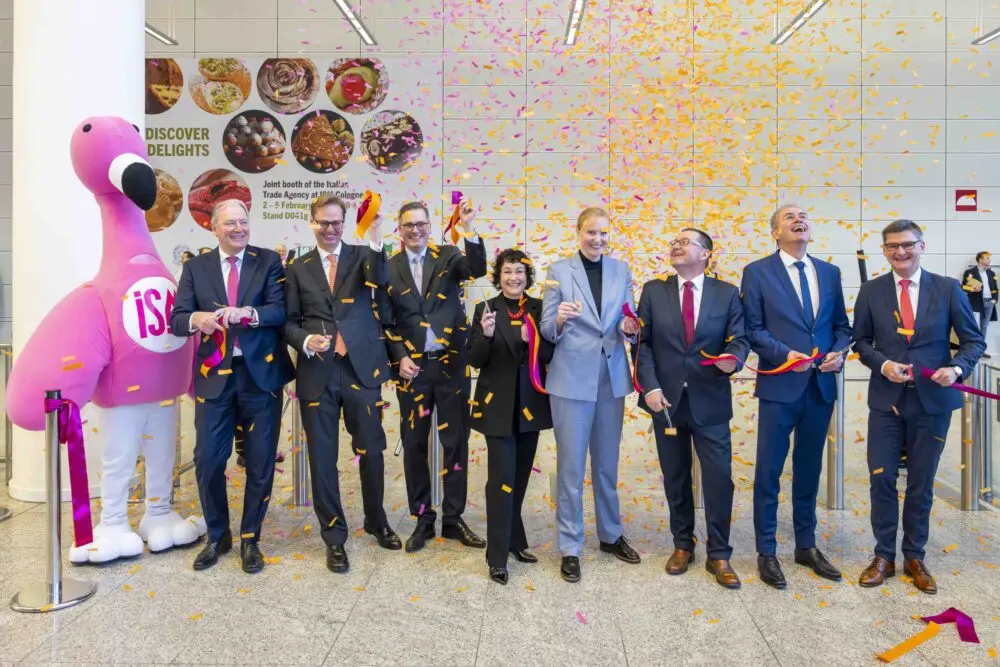
Ribbon Cutting ISM und ProSweets 2025, Eingang Süd
The sensors don’t always have to be installed statically and directly in the systems. Common polycarbonate moulds that pass through a chocolate system equipped with measurement technology can examine areas that are difficult to see, such as refrigerators, shaping stations and vibration. Mechanical influence parameters and temperatures can thus be monitored in real time. The sensors recognise, for example, transitions with non-parallel chains in a casting system in that the mould revolves around the vertical axis. Errors can in this way be detected early on, making it possible to initiate targeted measures before malfunctions occur.
Sensors with integrated intelligence
Smart sensors represent a perfect basis for the implementation of Artificial Intelligence for making data-based decisions. “AI and machine learning are high-performance technologies with the potential to enduringly change the manufacture of sweets and snacks. Even today, the systems act increasingly proactively, with the goal of improving quality standards and deploying resources more efficiently”, Guido Hentschke emphasises. Against this background, image-processing 2D and 3D vision sensors are currently on the march throughout the food industry. They guarantee that other products, different formats or new packaging tasks can be processed without additional effort on the same system.
The right product handling also makes a difference. Using AI-based image recognition, robots recognise different objects and reliably master the “grasp into disorder”. Behind this is sophisticated vision technology combined with five or six-axis pick-and-place kinematics. Evenly arranged in the tray or flow bag, the cookies or crackers already convince with their quality and optimal presentation when the package is opened.
In addition to high-performance pick-and-place applications, AI-supported vision sensors are in the meantime also a fixed element of quality assurance. They can classify gummi bears, bonbons or chocolates according to defined criteria as well as check portions and packages for the correct content and quantity. Progressive systems thereby rely on multispectral imaging. They recognise the chemical composition of foreign bodies in real time and identify glass and metal fragments or plastic particles in food products and packaging where this has to date not been possible.