
WCF Brazil meeting acknowledges greater need for urgent farmer support and training
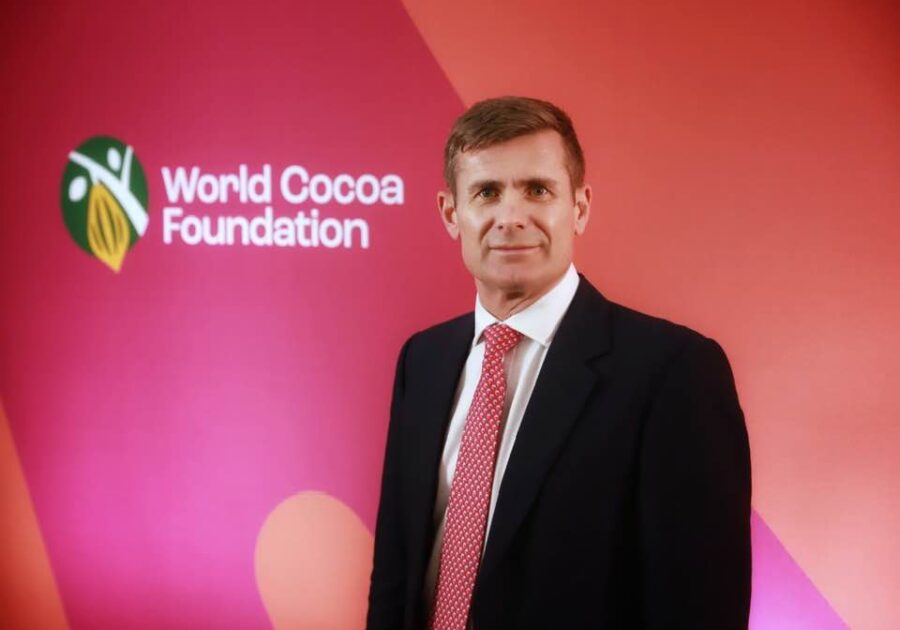
pic: president of the WCF, Chris Vincent in Sao Paolo. Pic: Tony Myers
“Crisis leads to innovation but it can also accelerate collaboration,” asserted Chris Vincent, President of the World Cocoa Foundation at its latest partnership meeting in São Paulo, Brazil, writes Neill Barston.
The senior executive appeared realistic yet determined to act in relation to the tests facing the sector, which saw crop prices spiral to $12,000 a tonne at the start of the year, as well as mounting climate and issues of child labour continuing to be a prominent factor.
A total of 500 global leaders participated in the event, making it the largest to date, with a focus placed on strengthening resilience and enabling sustainable growth through developments in key areas including data, research and disease management.
Moreover, as the organisers noted, there was a strong response to its theme of “Our Future: Resilience Through Sustainability”, which took place this month against a backdrop of considerable concern within core markets of Ghana and Ivory Coast, that have come under renewed strain due to a near perfect storm of major challenges.
The two-day summit convened representatives from governments, cocoa-growing communities, companies, civil society and academia. Speakers argued that global challenges such as climate change and disease have shifted the need for a sustainable cocoa sector from a moral imperative to a matter of survival. As the sector faces unprecedented pressure to deliver at speed and scale, this moment demands coordinated, practical approaches towards efficient execution.
Chris Vincent continued: “As the cocoa sector navigates a period of uncertainty and transformation, recent challenges have demonstrated its interconnectedness. The energy and solutions emerging from São Paulo show that the sector is ready collaborate to achieve resilience through sustainability, to invest in innovation and to support cocoa communities worldwide.”
Speakers emphasised that addressing the systemic issues in cocoa landscapes and communities requires pre-competitive collaboration, including with governments and farmers, to create sustainable, long-term resilience.
Hosting the Partnership Meeting in Brazil strengthened Global South-South collaboration and learning. Delegates explored how Brazil’s leadership in agricultural innovation – from crop diversification and regenerative farming to small-scale mechanisation – is supporting the country’s ambitions to double its cocoa production by 2030. Field visits and technical panels highlighted practical, scalable approaches to cocoa agroforestry and mechanisation that could support producer countries facing similar climate and productivity pressures.
As organisers noted, the breakout sessions explored how data-driven strategies – from income tracking to crop forecasting, disease surveillance and biodiversity – can support adaptation and bring an entrepreneurial spirit. Delegates underlined the need for data to be shared equally among origin and consuming countries, enabling farmers to make informed decisions that increase productivity and enhance the resilience of their income into the future.
Furthermore, one of the main challenges threatening world’s cocoa supply, panellists advocated for a comprehensive, shared research base around diseases and increased investment in disease prevention strategies like farmer training, improved planting materials and digital technologies.
Cocoa Sustainability Through a Business-Oriented lens
Plenary discussions examined whether historically high cocoa prices could catalyse transformation or deepen existing structural challenges. There was a shared consensus that resilience must be tied directly to productivity, profitability and farmer wellbeing, rather than short-term market gains. This must be clearly conveyed to the consumer, who needs a simple proposition.
WCF reaffirmed its role as a platform for pre-competitive collaboration and announced new cross-sector workstreams on regulatory compliance and global disease management. Progress also continues across the Cocoa & Forests Initiative and joint action plans to tackle child labour.
As the event closed, WCF and its partners issued a strong call for shared responsibility and action across the cocoa value chain. “Resilience is not just about surviving disruption. It is about building a system in which farmers, companies and communities can thrive,” said Vincent. “The conversations and commitments made here in Brazil will shape the future of cocoa and define the next phase of sustainability in the sector.” The event is due to return next February, coinciding once again with Chocoa in Amsterdam.
People
