
Focus: Form, fill and seal technology continues to evolve across global markets
Confectionery Production takes a look at the latest in form, fill and seal packaging systems for the confectionery and snack sectors, with updated features enabling increased efficiency, speed and agility and helping to meet the market challenges of today. Daisy Phillipson reports
Energy costs, skilled labour shortages and supply chain disruption are just some of the challenges facing food manufacturers today, including those operating within the confectionery, bakery and snack sectors.
Additionally, sustainability is arguably one of the biggest focuses right now. In terms of the packaging process, form, fill and seal machinery is a popular choice in helping to meet these standards. Using automated technology to create flexible or rigid packages, the process can reduce the risk of contamination and errors while increasing the speed, efficiency and flexibility required by the market today.
According to market research firm Future Market Insights, the global form, fill and seal machines market enjoys a valuation of approximately $11.5 billion in 2023, and is expected to grow at a CAGR of 4.5 per cent to reach $17.9 billion by the year 2032. Clearly, demands upon confectionery and snack manufacturers remain high, with Confectionery Production takes a look at the latest in form, fill and seal packaging systems for the confectionery and snack sectors, with updated features enabling increased efficiency, speed and agility and helping to meet the market challenges of today. suppliers of form, fill and seal packaging systems constantly updating their technology in order to deliver new benefits and overcome the unique requirements of their customers.
For those facing rising energy costs and sustainability objectives, flexible packaging machinery business IMA Ilapak – which offers a range of vertical (VFFS) and horizontal (HFFS) form, fill and seal machines – has upgraded all of the systems in its portfolio to digital servo technology. The use of the latest servo technology to power functions such as head height adjustment, infeed belts, jaw drives and film drives is said to have a dramatic impact in terms of energy efficiency as it reduces load on factory air conditioning units. Tony McDonald, sales and marketing director at Ilapak UK, explains: “Conventional squirrel cage motors use fans to stop the machine from overheating, blowing hot air into the atmosphere. The factory air conditioning system then has to work extra hard to cool the hot air that is generated. This isn’t necessary with digital servo motors, which translates to huge energy savings for our customers.”
To tackle the labour shortage and increase employee wellbeing, IMA Ilapak updated its continuous motion VFFS system, the Vegatronic 6400HD, to now include an automatic splicing feature. “Automatic splicing has always been a ‘pain point’ on baggers owing to the geometry in the forming tube,” adds McDonald. “Ilapak has overcome this challenge by designing a splicing process in which the films are angled in a way that guarantees successful splicing, thereby eliminating the need for manual reel changes.”
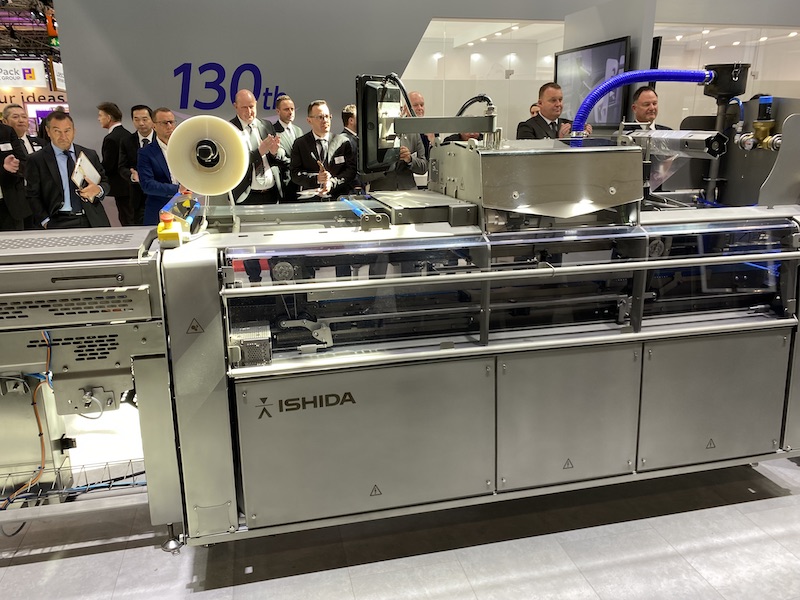
A significant equipment breakthrough has also been achieved by food weighing and packaging machinery firm Ishida Europe with the release of its latest VFFS bagmaker, capable of increasing speed, flexibility and energy efficiency for snack manufacturers. As Ishida (which exhibited a number of innovations at Interpack, including a new tray sealer in the main image) noted, according to Euromonitor International, value sales of snacks are expected to show higher growth rates during 2022 to 2026 than in 2020 and 2021, with healthy options projected to see the highest CAGR.
Innovation will continue to drive the sector with emerging trends including the introduction of sustainable packaging, diverse world food flavours, functional foods and on-the-go snacks. The company’s latest Inspira Boxmotion line has a reported thirty per cent upturn in speed over previous models. The VFFS bagmaker can operate in both continuous and intermittent motion modes, enabling it to handle the widest variety of both product and pack formats, including the introduction of recyclable film and paper packs. Box motion technology enables the sealing jaw motion to operate in both vertical and in/out horizontal planes, ensuring a more consistent and reliable seal. This technology can also handle all the latest pack formats which, in addition to pillow packs, include side gusset, block bottom, chain packs and flat bottom. Manual intervention is kept to a minimum thanks to a new splice table light-bar for easier and faster automatic film splicing, as well as automated features for switching between continuous and intermittent motion, centring film, managing air fills and adjusting tensions.
As the business concluded, its new line reportedly uses 17 per cent less energy when in operation and 25 per cent less energy on standby than previous models. Alongside flexibility, hygiene is an important factor when considering form, fill and seal systems. Addressing both of these requirements is packaging equipment business WeighPack Systems with the release of the sanitary version of its VF-1200 continuous motion vertical bagger for high pressure washdown needs. “We feel strongly that our industry requires more solutions for high sanitary washdown to help mitigate any risks of cross contamination or bacterial growth as a result of poor cleaning to ensure that the consumer remains safe,” says Nicholas Taraborelli, Vice President, WeighPack Systems.
Constructed in stainless steel with what is said to be the highest IP standards for motors, the VF-1200 offers a highly sanitary solution that’s been engineered with an open-frame design for easy operator access. Additional features include vacuum pull belts, second film roll support, film splice table, Omron motion controller and servos, a 15-inch colour touchscreen and tool-less removable vertical seal bar, horizontal jaws and a forming shoulder. In the context of flexibility, the VF-1200 can handle multiple package formats and produce a wide range of sizes for various food sectors including snacks and confectionery. Increased speed and efficiency are also top of the agenda for form, fill and seal systems today, not only for standalone solutions, but in combination with up stream and downstream equipment. At this year’s Interpak, processing and packaging machine specialist Syntegon showcased its turnkey solutions for the production of functional gummy and jelly products, from kitchen, depositing and finishing technologies to packaging solutions.
Following the processing stages on the turnkey NutraFlash line from the Syntegon subsidiary Makat Candy Technology, visitors were able to watch jellies being packaged into 75 millimetre-wide pillow bags with an output rate of 360 bags per minute on the SVX Duplex VFFS machine. The high-speed packaging innovation was combined with a Syntegon RPP robotic pick-and-place platform for product handling and a Kliklok ACE carton former for the full packaging solution.
At the company’s booth, the SVX Duplex transported the bagged jellies on two lanes to the Syntegon RPP, delivering fast and reliable handling at a speed of up to 140 picks per delta robot per minute. The RPP’s vision-guided delta robots are equipped with four-axis-kinematic arms that allow them to position products correctly. The RPP placed 18 bags each into shelf ready carton trays formed by the Kliklok ACE, which covers both glue and glueless lock-style closures, providing sustainable options for different carton styles. In the context of sustainability, not only can reducing waste and increasing energy efficiency help companies to achieve objectives, but these measures can have a significant impact on profitability. “Coupled with the rising energy costs, raw material prices have skyrocketed, with the price of sugar effectively doubling since 2020,” explains Simon Hill, Group Solutions Specialist, Packaging, tna solutions Europe. “This has put pressure on confectionery manufacturers to look at ways to increase efficiency and reduce overheads.”
The processing and packaging technology firm continually develops and updates its solutions, with smart features and capabilities taking a holistic approach to sustainability. At this year’s Interpak, tna showcased the abilities of its tna robag VFFS system to run a range of industry-compliant sustainable film materials. It demonstrated an integrated line for snack producers featuring the tna robag 3e and the tna auto-splice 3 with EtherCAT real-time protocol and an integrated display controller system. As highlighted by the company, the latest software relays information from the tna checkweigher or from the product in-seal inspection to inform operators on the optimal weighing bucket configuration for prompt troubleshooting, therefore reducing rejects and product and material waste.

As a result, snack manufacturers can now produce up to 2,800 more bags per line per day with minimal downtime and only 200 millimetres added to the VFFS system footprint. Additionally, two innovations enabling decreased energy consumption include tna’s rotary jaws and the power save function. The power save function automatically turns off elements of the tna robag, including the heater, servo motor controls and the user interface, within typical sized lines of 10 or more bag makers, which adds up to significant. energy savings. Meanwhile, tna’s rotary jaw technology saves energy as the free motion of the jaws rotate continuously with no friction. With the use of smart design features, the tna robag 3e is said to deliver energy savings of up to 20 per cent. “Holding off on updating equipment right now is effectively a gamble, as the instability in the market means we’re unsure of when the energy crisis might end, and how much worse it might get,” concludes Hill. “But having the equipment in place can reduce costs in the long term and help mitigate this risk, especially if energy costs continue to rise as the payback will compound as time goes on.”
