Wymbs collaboration with Siemens offers fresh robotics solution
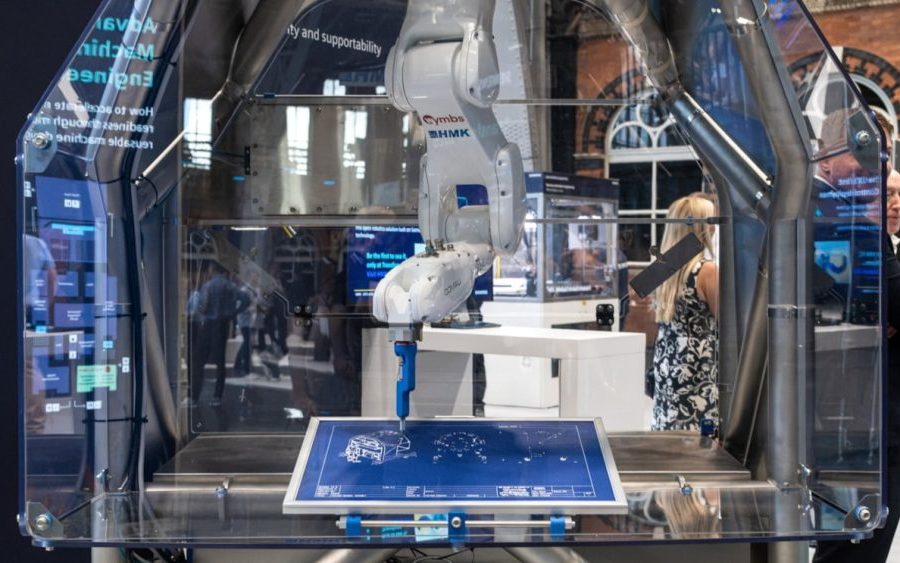
The new Vectrix system in operation. Pic: Siemens
Stockport’s Wymbs engineering has marked a successful collaboration with Siemens for a new robotic platform known as Vectrix, designed to assist manufacturers within confectionery and bakery with greater automation, writes Neill Barston.
The Greater Manchester business has gained a notable reputation for working with key industry businesses to deliver a broad range of industry solutions across depositing and processing lines.
Its latest collaboration takes the form of an open robotics platform that will also assist the wider food segment, aiming to deliver advanced automation to reduce repetitive product tasks, with less risk, cost and engineering complexity.
As Confectionery Production has previously reported from its Stockport site, the company’s achievements over the past four decades working with key major brand confectionery and snacking companies have made it a notable player in the sector.
Its latest system was a combination of work between Wymbs, Siemens, and HMK Automation & Drives, uses Siemens automation technology and its Totally Integrated Automation (TIA) Portal environment to bring robot control into the same environment used to manage other parts of a production line.
Together, this eliminates the need for robot vendor specific know-how, making industrial robots easier to integrate, operate and maintain in food manufacturing environments.
Unveiled during Siemens’ flagship Transform 2026 event in Manchester, the machine has been built around a fully modular design to allow the robotic cell to be adapted to perform a wide range of tasks, including pick-and-place handling, product depositing and customisation.
Whether placing fruit filling into a biscuit, injecting cream into a doughnut, decorating bakery products and picking and packing products, the cell delivers a flexible automation solution that can be reconfigured to meet changing production requirements.
The machine can also be fitted with an industrial-grade agentic AI application to support contextual image recognition and provide operator suggestions based on real time data. This will enable, for example, an unusual temperature gauge reading to be analysed by the AI agent, which will then provide possible reasons for the anomaly, based on machine data, and suggested fixes.
By adding industrial AI, the platform will give operators and engineers a more accessible way to understand machine behaviour, investigate faults and support maintenance. This is designed to reduce reliance on specialist programming knowledge and help production teams respond more quickly when issues occur.
As the company noted, robotics in food manufacturing often rely on manufacturer-specific controllers, software and programming tools. The new open platform reduces this complexity by using Siemens automation technology to control robotic applications alongside the rest of the production line, reducing the need for separate robot control systems and specialist programming environments.
Modular construction
The platform is modular and recipe-driven, allowing the same robotic cell to be adapted for different products and processes through software. This supports faster product changeovers and gives manufacturers greater flexibility to adapt to changing customer requirements, which can be changed quickly for seasonal demands.
Importantly, the machine has been built using off the shelf products complying to IEC-62443 standards, to allow for ease, and speed, of repair and replacement while supporting end-users with their cyber resilience strategies.
The launch comes as food manufacturers come under increasing pressure to improve productivity, protect margins and increase flexibility, particularly in categories where ingredient costs and labour availability can change quickly. Siemens, Wymbs and HMK Automation & Drives say robotics can support these goals by improving the precision and repeatability of processes such as depositing, filling, icing and decorating.
Lucas Laurie, Key Accounts Manager – OEM at Siemens UK & Ireland, said: “There’s huge potential for robotics and industrial AI to help food manufacturers overcome long-standing challenges around cost, labour availability and operational complexity. But the technology has to be practical. Companies need systems that are easy to integrate and simple to support.
“With Wymbs Engineering and HMK Automation & Drives we’re bringing robot control in the sector into the same standard automation environment many manufacturers already use across their production lines. That means robotics can be operated and maintained in a more familiar environment, rather than sitting apart as a separate system.
“The future addition of industrial AI is significant because it can help operators and engineers interact with the machine in a more intuitive way. That lowers the practical barriers to automation and helps manufacturers get more value from the technology on the factory floor.”
Thomas Kirkham, Automation and Robotics Manager at Wymbs Engineering, also welcomed the initiative.
He commented: “Food manufacturers are looking for practical ways to increase flexibility and productivity, particularly where processes are labour-intensive, repetitive or difficult to keep consistent at scale.
“Thanks to our close collaboration with Siemens and HMK, we’ve developed a robotic platform that can be adapted for different food production applications through software, rather than requiring a completely new machine design every time.
“The AI capability also gives operators and maintenance teams a more accessible way to understand and support the machine during production. That is important in busy food manufacturing environments, where teams need clear information quickly and cannot afford unnecessary downtime.”