
Nestlé acquisition of Brazil’s Garoto chocolates gains clearance after nearly twenty years
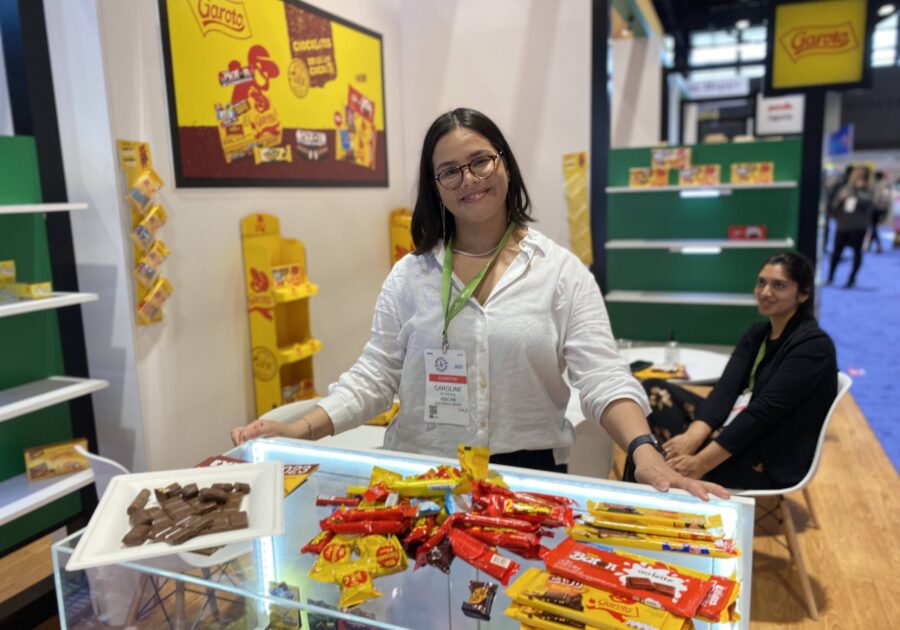
Garoto at this year's Sweets & Snacks Expo, Chicago. Pic: Neill Barston
After a near twenty-year legal case, Nestlé’s acquisition deal for Brazilian chocolate confectionery business Garoto has been given regulatory clearance from the country’s Administrative Council for Economic Defence (Cade), reports Neill Barston.
It has been agreed on condition of signing a merger control agreement, focused on corporate behaviour designed to preserve balance of fair competition within the region’s industry.
Among a number of key contractual obligations, is a commitment to maintaining confectionery manufacturing at the Garoto factory in Vila Velha (ES) in production for a minimum period of seven years.
Notably, in the long-running saga, the Swiss-headquartered food giant bought the established South American firm for a figure put at around €223 million in 2002, in a bid to significantly enhance its presence within the region.
However, just two years later, the move was vetoed by Cade, which is linked to Brazil’s Ministry of Justice, on the basis that it would result in a near monopoly of over 58% of the region’s chocolate market.
From there, in a further twist, this retrospective ruling was challenged by Nestlé in 2005, which four years later saw a court decision order a review of the merger, which remained unresolved for years. The case was further complicated by the introduction of Law No. 12,529/11 from May 2012, which changed the model of how competition rules are analysed and left further uncertainty over the case.
An additional investigation by Cade’s General Superintendence and review into the acquisition in June 2021 led to a positive outcome for Nestlé reportedly found that between 2001 and 2021 there was a significant entry of competitors in the segments that raised concerns in the first assessment of the case.
Specifically, it noted that chocolates in all forms (industrialised ready-to-eat ) and also in chocolate coating experienced a high level of competition in the past decade, with Nestlé/Garoto’s market share said to have fallen from 50%-60% in 2001 to 30%-40% in 2021, while, in the second category, the company dropped from 80%-90% to 20%-30% , meaning it was considered not to have a monopoly.
Consequently, according to Cade, the market conditions have been notably changed in the past two decades, and as a result, it did not believe the original decision to disapprove the business should be upheld. “This idea reverberates in the market perception that the impacts of the Nestlé/Garoto merger have already been absorbed by the market over these years”, points out its reassessment.
Deal conditions
As part of the latest ruling, Nestlé cannot acquire, for a period of five years, assets that represent, cumulatively, a share equal to or greater than 5% of the market.
This reportedly does not apply to international acquisitions, with effects in Brazil, carried out by the controller of Nestlé or a company of its economic group. In these cases, the merger must be notified to Cade, if it meets the prior submission criteria established by law. There were further stipulations including issues relating to taxation as part of the deal or move to acquire further local assets that would influence the national chocolate market for a period of seven years.
Cade president, Alexandre Cordeiro, explained the agreement aimed to preserve operating conditions in Brazil: He said: “Considering the more than 20-year history of this case and the existence of a new antitrust legal framework in the country, the negotiation between Cade and Nestlé resulted in an agreement with measures that are proportionate and sufficient to mitigate competitive impacts in the current scenario and safeguard the interests of consumers”.
