China demonstrates core confectionery sector growth
China’s confectionery sector continues to expand as premiumisation, ingredient innovation and global investment reshape the market, with strong consumer demand and e-commerce driving sustained growth. Daisy Phillipson reports
China’s confectionery industry is overtaken the United States as the world’s largest market within the sector. According to research firm Statista, global confectionery revenue is expected to reach approximately $648 billion in 2026, with China accounting for the largest share at an estimated $94 bn.
Key growth drivers are the country’s large population and emphasis on
gift-giving culture, leading to a demand for premium and luxury confectionery and chocolate ranges. There is also a rising interest in healthier options, including reduced sugar and organic products, while further momentum is gained from the country’s booming e-commerce market.
This appetite for premium and innovative products is also being reflected
in trade flows. According to a recent report from the Agricultural Trade Office (ATO) in Beijing, part of the USDA’s Foreign Agricultural Service (FAS), confectionery imports into China surged by nearly 40 per cent in early 2025, underscoring strong demand despite economic turbulence.
ATO Beijing notes how seasonal consumption accelerates sales, with both
Western holidays such as Halloween, Christmas and Valentine’s day proving
popular in first- and second-tier cities, alongside the traditional Chinese Spring
Festival. Younger consumers are reshaping preferences toward dark chocolate,
functional ingredients and mini formats, trends that are boosted by social media use.
Investment moves and expansion
Beyond strong consumer demand, structural investment continues to reinforce China’s confectionery sector. In June 2025, Ivory Coast inaugurated the China-backed cocoa processing complex in Abidjan.
As a collaboration between China Light Industry Nanning Design Engineering and the Cote d’Ivoire Coffee-Cocoa Council, the complex includes a cocoa processing plant with a capacity of 50,000 tonnes.
Additionally, a training centre for the cocoa and chocolate trades is aimed at
strengthening local skills and improving youth employability. The project forms part of wider cooperation between China and West Africa to expand cocoa processing capacity, ensuring more stable access to cocoa liquor, butter and powder for domestic chocolate manufacturers.
At the corporate level, consolidation and expansion have also gathered pace. Last year, Nestlé completed its full acquisition of Hsu Fu Chi, one of China’s most recognised confectionery brands. The Swiss multinational, which already had a 60 per cent stake, bought the remaining 40 per cent for full ownership.
The move strengthens Hsu Fu Chi’s access to Nestlé’s global brand
and resources while giving the multinational deeper access to domestic
distribution networks.
Meanwhile, Fazer Group – Finland’s leading producer of chocolates, sweets and
biscuits – sees strong growth potential in the country. The company is strengthening its presence in the Chinese market for oats and other grain-based products, noting the growing trend for healthier products. In
April 2026, Fazer is also launching its own flagship online store on leading Chinese platforms.
Ingredients and machinery
Amid the ongoing trend for health-driven reformulation, ingredient suppliers are ramping up their technical capabilities.
Tate & Lyle recently launched sensory formulation tool, Tate & Lyle Sensation,
in the Asia-Pacific region to help food and drink producers accelerate product
development and achieve ideal mouthfeel.
Growth in plant-derived proteins and clean-label ingredients is influencing
innovation strategies in China. Bioway Organic notes how consumers and brands are seeking ingredients that deliver not just protein content but also
phytonutrients, fibres and vibrant natural colours. For this reason, the company has noted a rising interest in its range, including its Organic Fruit and Vegetable Powder and tailored Nutritional Formula Blend Powder.

Gelatine and collagen suppliers are also scaling up to support confectionery and nutraceutical demand. Yasin, for example, reports annual capacity exceeding 20,000 tonnes across gelatine and collagen production, with GMP-compliant facilities and laboratory testing underpinning supply reliability for manufacturers serving both domestic and export markets.
Growth and expansion is not limited to ingredients, as China’s confectionery
machinery and packaging sectors continue to evolve. Chengdu-based LST Machine has reported scaling its chocolate moulding and coating equipment production lines, responding to rising global demand for automated chocolate manufacturing solutions.
In the world of packaging, Shanghai World of Packaging (swop) recently rebranded as interpack China, signalling the country’s growing strategic importance within global packaging networks. Thomas Dohse, director of interpack and interpack alliance, said, “As part of a global brand, interpack China brings together international and Chinese companies, granting exhibitors direct access to one of the most exciting and rapidly-growing packaging markets in the world.”
Sweet innovation
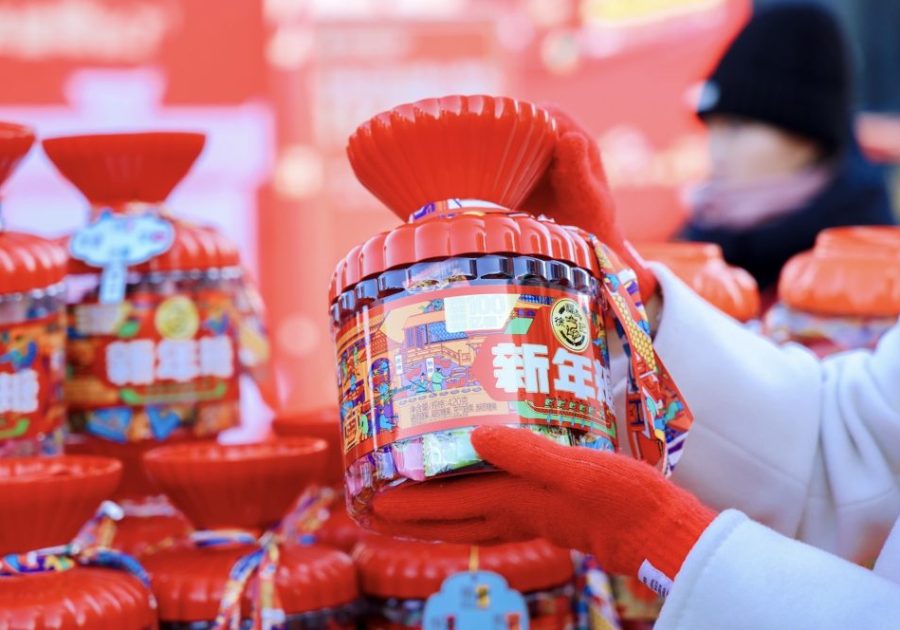
Product innovation remains a defining characteristic of China’s confectionery space. The most significant wave of new products came from Hsu Fu Chi, which launched over 50 core items for the 2026 Chinese New Year festive season. Among its innovations are peelable and 100 per cent fruit juice soft candies, as well as an upgraded version of its classic Crispy Candy and a New Year’s bucket inspired by the Tang Dynasty culture.
Elsewhere, Yumart recently announced the rollout of a new collection of ISO-certified 3D-shaped ice creams, which combine a variety of flavours with novel shapes such as roses and fruits. Each product is crafted with a high-density cream base to ensure structural stability and a smooth mouthfeel that complements its enticing exterior, in an aim to appeal to social media focused consumers.
In the liquorice segment, Ivy Candy presented its innovations and future plans at ISM Cologne 2026. Among its latest products is the Cigarette-Shaped Bottle Sour Powder Candy, which taps into demand for sweet yet sour tastes. Within this same trend is the company’s Sour Crispy Coated Filled Chocolate Candy, combining a crisp, tart candy shell and creamy chocolate. Looking ahead, China’s confectionery market is expected to continue its expansion, with growth driven by premium, health-oriented and artisanal products, robust e-commerce channels and culturally relevant innovations.
With strategic investments and responsiveproduct development, the country is poised to remain a major engine of growth in the global sweets landscape.
People