
Caobisco expresses hope for EU free trade deal with Australia
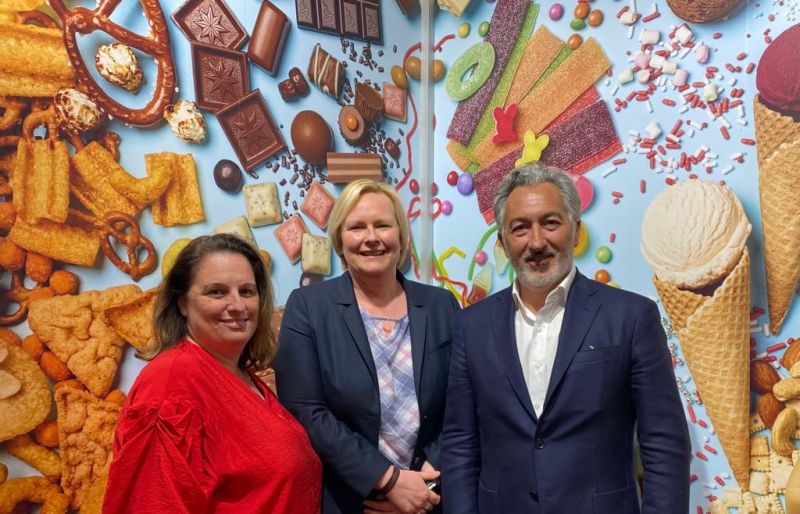
Barbara Blohberger, vice president of Caobisco (left of pic), joins Caobisco director general Muriel Korter, and Aldo Cristiano, the organisation's president, at ISM, which hosted the latest ICA meeting. Pic: Caobisco
Caobisco European confectionery trade association has expressed hope the EU’s negotiations for a free trade agreement with Australia will be concluded successfully, reports Neill Barston.
As the key industry body noted, there is a ‘strong solution’ to be arrived at that would be mutually beneficial to both sides in boosting sector sales – with negotiations over sugar import volumes being of critical importance.
Notably, as Caobisco, which will be making a keynote speaking appearance at our World Confectionery Conference this October, observed, Australia remains a key export market for European sweets and confectionery, and any meaningful strengthening of the existing $100 billion trade ties between the two regions would be welcome in its view.
However, as it acknowledged, there have been reservations expressed by Canberra-based representatives, led by Prime Minister Anthony Albanese, and trade minister Don Farrell, with concerns over whether sufficient access to EU markets would be offered.
Significantly, the EU has held firm in its rules of origin conditions that effectively mean that Australia would have to remove food product names from around 166 items, ranging from feta and brie, though to more than 200 spirits – protecting these as location-specific products, effectively blocking alternative domestic production by other nations.
“Australia is one of the most significant destinations for European confectionery. In addition to seeking greater market access, our sector also aims for simplified export procedures,” says Karsten Daum, Chair of the Economic Affairs Committee of Caobisco.
“We therefore urge the EU to take complexity out of the conditions for freer trade. This will also serve in particular small and medium sized companies,” adds Mr. Daum. CAOBISCO has been calling for value-based rules of origin under the EU-Australia Free Trade Agreement (FTA).
“Value based rules of origin take into account the fact that the EU is a net-importer of sugar, and that this domestic deficit will most probably last in future due to climate change impact on beet,” explains Mr. Daum.
Furthermore, other Free Trade Agreements like EU-Canada or EU-South-Korea have proven, that value-based rules of origin do not harm the European sugar sector.
In Caobisco’s view, an even better approach on the rules of origin was taken in the United Kingdom-Australia Trade Agreement – though this has itself come under close scrutiny from some observers and industry groups noting that the actual net trade benefit to the UK is perceived as being substantially lower than government sources had original projected.
As Caobisco noted, a simple rule “change of tariff heading” recognises the substantial transformation of inputs into processed goods.
On the other side, the organisation sees a mutual benefit for Australia’s interests in better market access for its agriculture sector.
“It is in the best interest of European manufacturers of confectionery, chocolate, and fine bakery products that the EU diversifies its supply options for sugar,” states Muriel Korter, Director General of Caobisco.
“Therefore, we need a large tariff-free volume of sugar from Australia. We have witnessed the overly restrictive import system for sugar in the current marketing year, and new import options are urgently required,” concludes Ms. Korter. In the trade agreement with the United Kingdom, Australia secured a market access for 80.000 tonnes of raw cane sugar. In CAOBISCO’s opinion, the agreement with the EU must include a significantly higher import volume.
Furthermore and in order to face immediate shortages, the FTA must provide for a significant amount for white sugar imports, which can be used directly and more rapidly by sugar-using food and drink manufacturers. CAOBISCO does not see any risks putting the EU’s defensive interests at stake.
However, the EU should not overlook its offensive interests. With over 12% of its production intended for the global market, the confectionery sector is a vital component of EU exports. CAOBISCO urges the EU to prioritise the export competitiveness of European confectionery manufacturers and emphasizes the crucial importance of securing better access to sugar. Australia provides a significant opportunity to achieve both of these objectives.
People
