
Barry Callebaut completes annual general meeting, amid deforestation and climate change recognition

pic: Barry Callebaut
Barry Callebaut has concluded its Annual General Meeting 2022, led by Patrick De Maeseneire, chairman of the board, as it gains recognition on improving its climate change and deforestation action plans, writes Neill Barston.
A total of 804 shareholders attended the gathering yesterday (December 14), in Zurich, representing 4,121,340 shares and equaling 75,1% of the issued share capital.
As the company confirmed, all motions were adopted as proposed by the Board of Directors, including the reelection of Patrick De Maeseneire (pictured) as chairman and the election of Thomas Intrator as new Board member.
The meeting comes as the business was this week recognised for leadership in corporate transparency and performance on forests by the global environmental non-profit organisation, CDP, securing for the second time a place on its annual ‘A List’
According to the company, the honours are based on data reported through CDP’s 2022 Forests questionnaire, which listed the Swiss-headquartered firm as one of the 25 high-performing companies that achieved an ‘A’ rating – out of nearly 15,000 companies scored. In addition, it gained a fifth consecutive year an ‘A-’ rating for our carbon reduction efforts. CDP’s annual environmental disclosure and scoring process is widely acknowledged as the gold standard for corporate environmental transparency and action.
Earlier this year, the business also gained another accolade from CDP as a Supplier Engagement Leader, working towards achieving science-based targets, tackle climate change and targeting becoming ‘carbon and forest positive,’ in its approach to its business activities.
As Confectionery Production noted at this year’s Choco Tec event held in Cologne this week, a presentation by the business hailed satellite mapping as ‘gamechanging’ for the sector, though the company acknowledged there was still significant work to be done in further reducing its impacts. As the presentation noted, the cocoa sector has historically played a significant role in deforestation in key producing markets of Ivory Coast and Ghana. In Ivory Coast in particular, a total of 80% of natural forests have reportedly been lost over the past five decades due to industrial activity, including illegal mining operations that have further impacted on the country’s under-pressure ecosystems.
Notably, the company stated that ‘deforestation and forest degradation are major environmental challenges of our time,’ and observed that the main driver is the expansion of agricultural land linked to commodities such as soy, palm oil and cocoa, all three ingredients found in chocolate products. Land use change (LUC) emissions, meaning the carbon emissions resulting from the conversion of forest and other land to agricultural land. It also forms a big part of Barry Callebaut’s carbon footprint, which the company maintains it is continuing to address.
It cited several key areas of progress, including implementation of innovative technologies in collaboration with academia, startups, and other stakeholders, in a bid to scale up its actions on carbon reduction and forest protection.
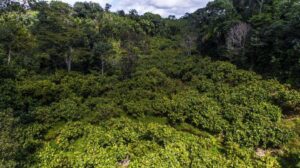
This has involved a partnership with EcoVision Lab, part of the Swiss Federal Institute of Technology (ETH) in Zurich, Switzerland, an industry-first, publicly available High Carbon Stock (HCS) map that indicates forests with high conservation values and areas where deforestation would cause the highest emissions. According to the company, this has assisted its suppliers identify the forest areas where preservation and protection activities have to be enhanced. It also devised what is claimed as an industry first for satellite-based assessment approach for cocoa-related LUC emissions.
Critically, the business has devised it Deforestation-free Protocol, published in 2021/22, noting processes being developed to reduce deforestation within supply chains for cocoa and other ingredients. The company asserted this was essential to monitor and prevent deforestation, the traceability of ingredients.
Consequently, its actions are covering 230,749 farms mapped within 25 kilometers of national parks, game reserves, forest reserves, and classified forests 1 and 2 in Ivory Coast. This has been combined with information on other farms mapped, delivering GPS data for 399,413 farms, covering 79.7% farms in the company’s supply chain – which it is seeking to raise to 100%.
Oliver von Hagen, Director Global Ingredients Sustainability at Barry Callebaut welcomed the company’s latest recognition from CDP. He said: “Being part of CDP’s ‘Forests A List’ for the second consecutive year is a remarkable recognition of the work we do under Forever Chocolate, our strategy to make sustainable chocolate the norm. Not only have we made significant progress on traceability, deforestation risk management and monitoring of our supply chains. We are also developing an emissions reduction program that is innovative, ambitious, science-based and sets new standards. This rating by the CDP is a testament to our team’s leadership in this space, one that makes us proud and encourages us to double down on our efforts.”
Board reappointment
For this year’s board meeting, all members, namely Patrick De Maeseneire, Markus R. Neuhaus, Fernando Aguirre, Angela Wei Dong, Nicolas Jacobs, Elio Leoni Sceti, Tim Minges, Antoine de Saint-Affrique and Yen Yen Tan were reelected for another term of office of one year.
The shareholders also approved the proposed payout of a stable dividend of CHF 28.00 per share. This corresponds to a payout ratio of 43% of the reported net profit. The dividend will be paid to shareholders on, or around, January 11, 2023.
Notably, KPMG AG, Zurich, was reelected as auditors of the company for fiscal year 2022/23, with its 2021/22 period having closed on August 31, 2022.
The meeting concludes a particularly eventful year for the business, which saw the launch of its Second Generation chocolate, which promises artisan-inspired sustainably-focused production methods for its latest ranges that are targeting the premium sector of the market.
As previously covered, the series was launched last month at a high profile event in Venice, with the company confirming that it is set to release the series with several grades of cocoa-content, though it has yet to be commercially adopted by major confectionery brands.
Organisations
