
European Cocoa Association Forum addresses key sector issues
The opening day of the European Cocoa Association Forum has completed with engaging debate and discussion across its core topic areas of supply chain issues, food safety and market innovation, writes Neill Barston.
Harold Poelma, the ECA’s former president gave an opening address which expressed optimism for the sector’s future, while acknowledging key challenges facing the industry
He said: “The demand for chocolate has shown tremendous resilience during the pandemic, but we will not stand still – and in understanding this, the shift that has happened in channels within the business, and the agility shown, has been impressive. We are now living through times of change,” he explained noting there were some key tests ahead within supply chains.
Among the core issues he noted were business disruptions within freight transportation – notably at core port locations as well as procurement issues relating to equipment and systems, which in turn has impacted on productivity levels within the industry, as it has across many spheres of industry.
Furthermore, Poelma also noted that the ongoing conflict in Ukraine has also caused significant impact upon ingredient supply chains – which remain critical for the wider confectionery sector, along with the ongoing significant issue of climate change affecting agricultural communities around the world.
Despite such tests, he believed that the overall growth trend for cocoa-related products within the market had offered genuine cause for hope – which emerged as among the major themes of the day.
The morning session also included an investigation of food safety matters for the sector (see our wider coverage in the next edition) and also focused on supply and demand functionality within global markets, that included an address from Pam Thornton, commodity trader. She raised a number of long-term issues facing the industry that had given cause for concern.
Among the core observations she made was that there there appeared to be ‘low or no’ integration of cocoa into wider agricultural policies within West Africa, which she believed was a key factor that impacted on the quality of broader infrastructure within the region. She also pointed to a lack of risk management strategies within the cocoa market as another factor that needed to be addressed.
Another notable point she raised was that of whether physical stocks of cocoa should still be traded (as opposed to advanced stockmarket trading), which she felt was potentially to the disadvantage of farmers against the backdrop of a sustained period of weakened prices. In her view, such an intervention, along with enforcing a farmer floor price for cocoa were measure that would be worth considering in a tight market.
The session, moderated by the organisation’s also heard from Steve Wateridge, head of research at Tropical Research Services, who explained how cocoa prices had gone from record highs in the 1970s of around $5000 a tonne, to its present rates, which are notably down on that period. However, he believed that despite the pricing situation, there was still resilience in the wider market.
This view was also shared by Jonathan Parkman, joint head of agriculture at Marex Financial, who asserted that it was important for present cocoa trading forward markets to be maintained, as he believed the system enabled a consistent market for trading that would otherwise be lost.
For the afternoon session, the event honed in on the topic of industry innovation within the sector, which included a presentation from Cristiano Villela Dias, from Brazil – examining how the country’s cocoa industry is once again rising, with a number of emerging companies seeking to take advantage of diversified product opportunities for cocoa. Meanwhile professor Ken Giller offered a viewpoint on sustainable cocoa production methods.
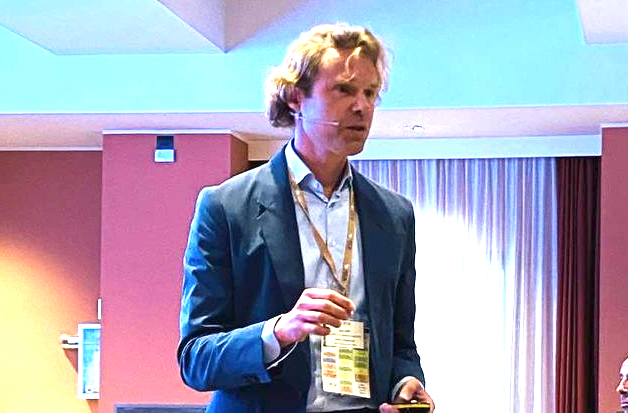
The session concluded with Bas Smit (pictured main image), global vice president for marketing at Barry Callebaut, who offered an engaging presentation on the value of engaging with consumers to meet both their needs and aspirations.
He examined several key consumer mindsets, exploring how best to reach out to potential customers and making them feel that products matched their lifestyles – such as the ‘conscious consumer.’
In addition, he highlighted some key products in development including its Elix drink, which is being devised as an important health-benefitting sidestream of cocoa.
