
Colouring partnership forged between Oterra and Vaxa for striking arctic blue
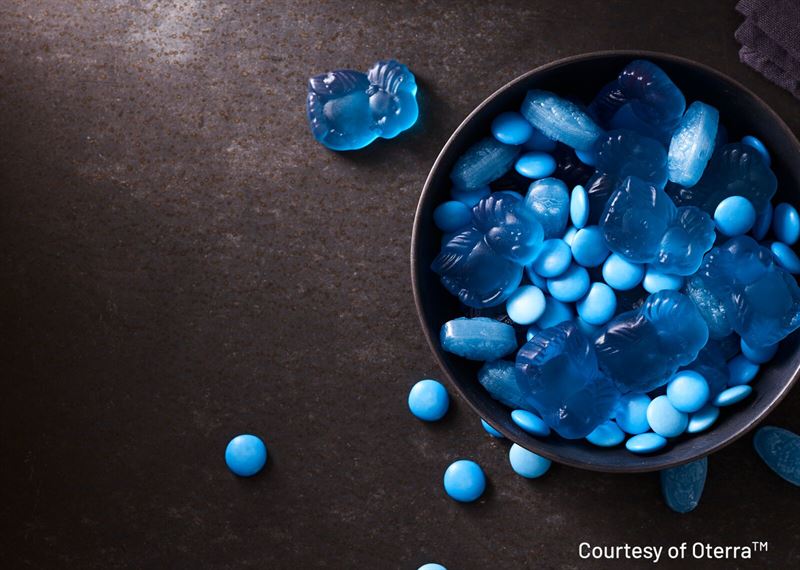
An innovative partnership has been formed between Danish natural colouring group Oterra and Iceland’s Vaxa Technologies to forge a new natural arctic blue shade for confectionery developed with a low carbon footprint, writes Neill Barston.
The new variant, which is a debut venture between the two companies, has a broad range of applications for the sector, and includes potential use within bakery, ice cream and dessert products ranges.
It features Spirulina made in Iceland using an innovative cultivation process will provide food and beverage producers with a vivid, natural blue colour with an impressively low carbon footprint.
“At Oterra, we are constantly seeking new natural colour solutions. Our partnership with VAXA Technologies is a prime example of our commitment to innovation and sustainability,” says Luc Ganivet, Oterra’s Chief Innovation Officer.
VAXA’s production in Iceland is in the sweet spot between Europe and the US, close to the markets that use the most spirulina in food and drink products, and where Oterra has its main manufacturing sites, to offer an unbeatable security of supply compared to other sources.
“By teaming up with this high-tech startup, we are able to produce spirulina-based natural colors using a state-of-the-art carbon neutral cultivation process that’s much closer to Europe and the US than most existing suppliers,” adds Luc Ganivet.
The high-tech production facility is next to a geothermal power plant that provides 100% clean energy, waste heat and carbon dioxide to VAXA’s bioreactors where the spirulina is grown 24 hours a day.
There is minimal loss of water from the closed system that has a significantly lower land footprint than traditional open pond systems. The carbon neutral cultivation process uses only 1% of the water and land compared to traditional open pond systems.
As the business added, the use of spirulina as a colour in food and beverage new product development is gaining popularity, according to Innova. It is also reportedly ahead of Brilliant Blue/FD&C Blue 1 artificial colour, with the most common use is in Confectionery (48.4%) followed by Bakery (15.9%), Desserts and Ice Cream (11.6%).
Moreover, processing, packaging, and transportation add some carbon dioxide emissions back into the equation, but initial analysis by Oterra suggests that it still has up to 40 times lower carbon emissions than the company’s conventional spirulina product.
With its unique sustainability profile, Arctic Blue can help Oterra’s customers reach Scope 3 targets by reducing their value chain emissions.
The spirulina algae used in the system is the same as in open pond systems, but the production process also solves some traditional issues with conventionally grown spirulina, while keeping its benefits.
“Arctic Blue has a neutral odour, contrary to algae grown in open ponds,” says Lotte Jeppesen, Industry Marketing Manager for Oterra. “It is also easier to mix and dissolves faster, which makes it better for handling. However, it keeps the common characteristics of spirulina such as the same vibrant blue shade and a high colour strength, while legislation and labeling are unchanged.
People
